Award winner
Find at
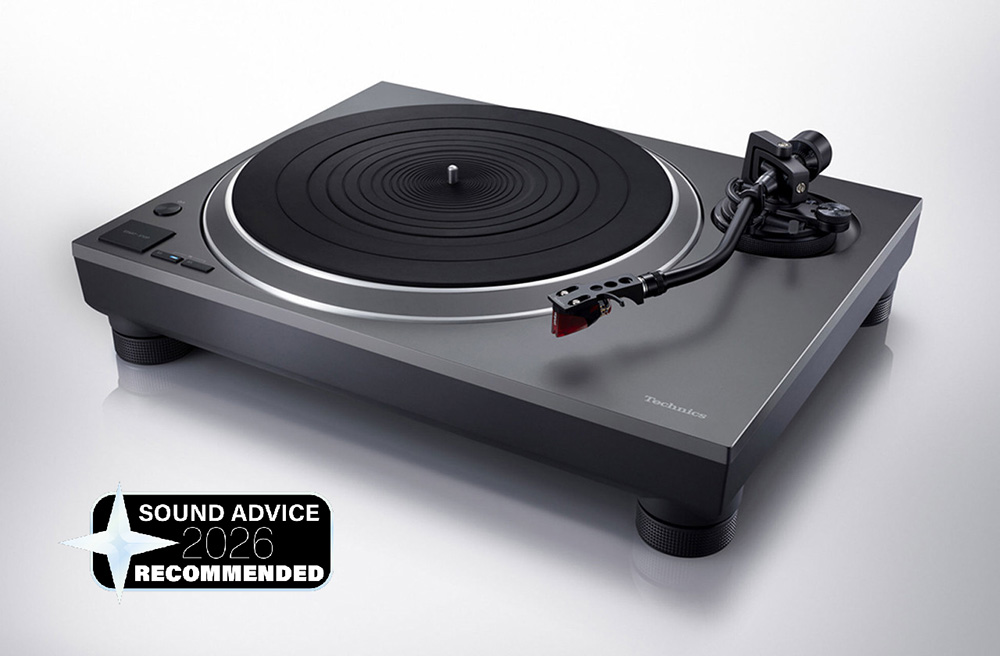
When we think about direct drive turntables, it is the SL-1200 family that people tend to visualise, complete with their pitch controls and other pro-audio niceties that mark them out as something a little different to more conventional offerings. Even back in the 1970s, though, that hefty direct drive motor assembly was also used in more domestically orientated designs that trimmed the functionality to offer a simpler user experience. Technics channelled this heritage to release the SL-1500C back in 2019 and it's now been updated to become the SL-1500CS.
The key addition to the SL-1500CS is the Delta Sigma Drive system we first saw in the SL-1200GR2. This uses pulse width modulation to control and form the power sine wave being used to drive the motor. Technics says that Delta Sigma Drive results in a lower noise floor, greater pitch stability (although it’s worth noting that even their turntables that went without this technology still had exceptional pitch stability) and lower vibration. This last part is especially important with models like the SL-1500CS because the platter is ‘only’ weighty rather than possessing the neutron star-style density of the premium models. Shorn of the pitch control, the SL-1500CS can be called upon to rotate at 33.3, 45 and - quite unusually in this day and age - 78rpm.
This new drive hardware is mated to a turntable that keeps the same recipe as the original SL-1500C - because there was absolutely nothing wrong with those ingredients. The CS has an internal moving magnet phono stage, allowing it to be connected to a line level input. Like the original, this is a well-implemented example of an internal phono stage because you can completely bypass it and use a set of terminals that provide a standard output for a phono stage, rather than powering the phono stage off and routing the signal through it (which is an approach a few rivals take).
Also retained is the S-shaped tonearm that uses a detachable headshell - in this case it comes with a pre-mounted Ortofon 2M cartridge. The combination of this and the phono stage means that the Technics is effectively able to function into anything with an analogue input, straight out of the box with no extra hardware needed. What’s quite clever about this though - as I shall cover - is that you don’t have to leave the Technics in this spec if you don’t want to.
Sound Quality
In the same way that there was absolutely nothing wrong with the specification of the original SL-1500C, there was very little wrong with the performance either. As a result of this, if you’re looking for something radically different from the 1500CS you are likely to be disappointed - but it represents the idea of taking a good turntable and equipping it with the means to do that little bit more.
The addition of Delta Sigma Drive doesn’t change the character of the turntable at all. This is still a big, confident-sounding device that has some of the best bass you are going to hear on a turntable at this sort of price point. By this, I don’t simply mean that the SL-1500CS has plenty of low end (although it can hit impressively hard when the need arises). It is more that beyond the out-and-out extension, there is an effortless presence to the lower registers of the Technics that comes about thanks to a level of detail and articulation that makes bass a tangible part of the music rather than a blunt instrument.
This isn’t actually the most significant contribution of Delta Sigma Drive though. Like the SL-1200GR2, there is a genuine and appreciable step forward in the quality of soundstage and stereo image that the SL-1500CS can generate. This isn’t as simple as making everything sound ‘bigger.’ It means the Technics can take large-scale and congested pieces of music and make them sound more three-dimensional and convincing - it can find the space and order needed to make them more convincing performances rather than presentations.
These changes also highlight quite how good some existing aspects of the Technics actually are. The lower noise floor facilitated by the Delta Sigma Drive highlights the internal phono stage Technics has fitted - it is every bit as quiet as the new noise floor and it’s also capable of accurate and believable tonality as well. This is not a convenience feature, it’s a genuinely capable bit of hardware in its own right and something that has the scope to outperform the internal phono stages of many amplifiers.
So what’s the catch? Such as it is, it’s pretty much the same as affected the original SL-1500C. The Ortofon 2M Red cartridge is a respectable performer, and Technics has squeezed out pretty much all it has to give - but there are rival turntables for the same sort of price that are shipping with rather more sophisticated designs ,and these can achieve levels of detail retrieval and top-end refinement that the Technics isn’t always able to match. As a device to get you started, it’s perfectly OK - but the SL-1500CS has more to give.
Living with the Technics SL-1500CS
Even though it took a few years off, Technics has been making turntables for a very long time - and this experience shows with the SL-1500CS. It comes out of the box in a way that is utterly logical and intuitive; Technics has even improved the packaging from the SL-1200GR2 to help the process. The CS features the positioning of the mains socket and output connections that everyone is ‘treated ‘to on the GR2 and it’s every bit as unpleasant here - but once connections are made you can ignore it.
Once it’s sat on your rack, you can revel in the quite superb build quality. Since the original launched in 2019, key rivals have learned a thing or two about bolting their products together - but the SL-1500CS is still a cut above, feeing both extremely solid and peppered with excellent details. There is still something profoundly satisfying about how quickly the platter reaches the correct speed after you press the start button and, in turn, how quickly it comes to a halt again afterwards. The tonearm incorporates an auto lift to take the cart out of the run-out groove and, interestingly, this seems better adjusted to reach the end of very long sides than it was on the original. You get a lid too, which is always welcome.
There is an aesthetic change for the new model that I’m not completely sold on, though. The original came in silver or black finishes, whereas the new arrival comes in a dark grey that splits the difference. I’m not sure the 1500CS is as pretty as the old 1500C. The black arm and generally darker finish means it doesn’t have quite the same presence as the silver of the original. This is all deeply subjective, of course, and you may vigorously disagree with me.
Something that I suspect is less up for debate is how far you can ‘stretch’ the SL-1500CS after you’ve bought it. The basic platform of the Technics is sufficiently good that it can be stretched into a record player that is comfortably superior to any similarly priced rival - and, crucially, better than you can likely make those decks if you spent the same amount of money too. Experiments with an Ortofon 2M Blue stylus and then an Ortofon MC 20X moving coil, various weights and stabilisers and an aftermarket mat, all yield more performance from the SL-1500CS than it is capable of out of the box. This is a very good £1100 turntable but, if you are of a mind to, it can become a truly great £1700 - £2000 one and do so at the time of your choosing.
Conclusion
What this means is that the Technics will keep any rival turntable at the price honest - and many people will be drawn to its imperious pitch stability and superb bass and airiness. For people willing to tweak the basic offering too, it offers the scope to grow with your system in a way that very little else at the price can.
Listening Notes
Chameleons Why Call it Anything?
An older, wiser record from an older, wiser band allows the Technics the chance to unpick these surprisingly complex songs and deliver their passion and sheer engagement with real aplomb
Nils Frahm Spaces
Historically, Technics turntables would deliver the weight and scale of this stunning album but be less assured with the space and delicacy. The Delta Sigma-equipped SL-1500CS proceeds to nail all of it.
Moby Play
An album that really deserves a re-listen now it’s not being played everywhere, all the time. The huge bass notes of Run On are grist for the Technics’ mill and it sounds ‘right’ in a way that is hard to describe but easy to experience.
If you have a large and varied record collection and an allergy to faff, things don’t get much more sensible than this. This unflappable user experience is now accompanied by better performance than ever before.
A combination of the Technics, the Marantz Model 60n and Wharfedale’s magnificent (and equally grey) Evo 5.4 would give you a fully specced system that will punch well above its weight and deliver even in larger spaces.