
Award winner
Find at
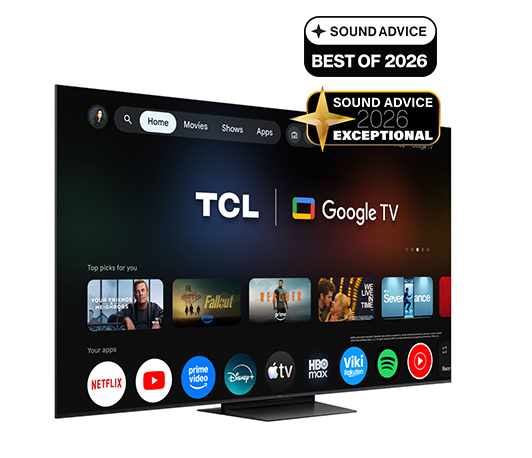
Winner! Best of 2026: TV under £1500

TCL, in case you were in any doubt at all, is ever so serious. Last year’s C7K MiniLED TV range was an instant hit, thanks to a potent combination of specification and performance that made the price look conceivably like it might be a misprint - and now TCL is back with what, on paper, looks an even more assertive and aggressive proposition.
For £1299, TCL will sell you a handsome-in-an-anonymous-kind-of-way 65in TV with quite a few specification highlights. The biggest attention-grabber is the fact that the 65C7L is a MiniLED TV, one that features Super Quantum Dot technology. For the avoidance of confusion, this means the TV uses an HVA 2.0 Pro LCD panel (chosen on the basis that it offers relatively wide viewing angles and relatively low reflectivity) backlit by a huge number of tiny LEDs (in this instance they combine to create an impressive 1152 discrete and individually controllable dimming zones). Colour is created by a similarly massive number of Quantum Dots that use five, rather than the more common two, layers of material to optimise their brightness, efficiency and stability. This is only the second range of TVs ever to feature this remarkably complex and, presumably, expensive arrangement - the first, you may not be completely surprised to hear, is TCL’s pricier C8L range.
The idea is to deliver a screen that’s capable of prodigious brightness (TCL is claiming 3000 nits here) and serves up a wide-ranging colour palette. At the same time as controlling its backlighting properly and offering a passable off-axis viewing experience at the same time, naturally.
Of course, specification as cutting-edge as this requires more than one or two racy-sounding technologies if its potential is going to be fully realised. Among the highlights are ‘All-Domain Halo Control System’, which attempts to prevent haloing during high-contrast scenes (which, of course, is more than likely when you consider the significant brightness this screen is capable of generating), and the ‘Deep Colour System’ that is charged with maintaining colour fidelity in every circumstance. Given a) the potency of the TCL’s colour-generating features, and b) the fact it covers every HDR base - HLG, HDR10, HDR10+ and Dolby Vision IQ are all on board - ‘Deep Colour System’ would seem to have its work cut out. The fact the C7L is certified IMAX Enhanced too is not a bad encore, either.
The C7L has an audio system that’s the result of TCL’s ongoing relationship with Bang & Olufsen. Compared to the amount of information that’s available regarding the video aspects of the TV’s specification, details about the audio stuff is hard to come by - there are a couple of exposed drivers on the rear of the screen (bass drivers, judging by the size of them), but as regards configuration, channel count and all the rest of it, it’s a mystery. Yes, the C7L can deal with Dolby Atmos and DTS:X spatial audio soundtracks, but I am prepared to posit that ‘compatible with spatial audio’ is not the same as ‘delivers spatial audio’.
Picture quality
I guess the temptation, when a company realises it’s able to liberate a huge amount of light from a TV panel, is to make the most of it in all circumstances. Happily, though, TCL uses the impressive brightness of the C7L to serve the content it’s displaying, rather than to bludgeon the viewer into submission.
There’s proper intensity to the brightest scenes in HDR content, of course - but it’s not at the expense of subtlety. Details don’t bleach away, and even though black tones inevitably lack the outright depth of the equivalent OLED TV, the brightness that’s available here doesn’t wash or fade the darkest tones - information regarding tone and texture is always available, along with out-and-out punch. And in between the extremes of dark and light, the C7L’s colour palette is notably varied and wide-ranging. The TCL can be as vivid as you like when the content demands it, but is equally at home when asked to do ‘muted and understated’ - and again, there’s a lot of variation displayed, along with gratifying insight into texture as well as tone. It controls tight patterns well in every circumstance, and once you’ve spent a few moments in the set-up menus the C7L handles on-screen motion with real confidence too. In short, this is an extremely watchable TV when it’s given some 4K HDR content to work with.
And within reason it’s a very adept upscaler too. Full HD stuff is, inevitably, slightly softer and slightly less detailed, but it’s composed and convincing all the same - and the C7L remains bright and colourful even when upscaling complex and/or fast-moving images. It’s only when you step down to standard-def content that the TCL indicates just how hard it’s working - but smearing, iffy edge-definition and a generally rather hazy look are pretty much par for the course when you ask a big TV to upscale some daytime TV, let’s face it.
Feed the C7L some stuff from a games console and, if anything, it’s an even more compelling demonstration of its powers than broadcast TV or 4K Blu-ray content. Not only does it have sky-high fresh rates, super-low latency and absolute motion stability - all essential to a great gaming experience - its brightness and its colour fidelity mean games look great, especially lighting effects.
Nothing’s perfect, of course, and the TCL can quite often allow a hint of picture noise in - sometimes this will be because of the source material it’s displaying, of course, and sometimes it’s a by-product of the work the screen has to do when upscaling sub-4K images. The HVA 2.0 Pro screen, despite TCL’s claims, is both noticeably reflective and suboptimal when viewed at an angle - the TCL will quite happily betray its backlighting to anyone sitting significantly off-axis.
sound quality
Given that so little information regarding the audio specification is forthcoming here, it’s difficult to know if the TCL 65C7L sounds better than the sum of its parts, worse or just about right. What I know for certain, though, is that the sound quality here is underwhelming and compares quite unfavourably to the quality of the images on offer.
It’s reasonably detailed, at least, and although it’s on the thin side where tonality is concerned it is at least prepared to hint at the bottom end of the frequency range. Wind the volume level up anywhere beyond ‘modest’, though, and the C7L readily sounds rather stressed and compressed. It’s just as well there’s plenty of room for a soundbar beneath the bottom of the screen.
living with the TCL 65C7L
This, of course, is ‘just’ a television - which means it has not been ‘designed’ so much as it has been ‘constructed’. TCL has done a perfectly decent job with the C7L, of course - it’s quite slender (56mm at its deepest point), its bezels are narrow, and the standard of construction and finish is perfectly fine. The plastics that make up most of the frame don’t feel anything special - but then you don’t routinely go touching your TV, do you? About the biggest fault I can find with the design of the C7L is the central pedestal stand - it raises the screen to the point that your average soundbar will happily fit beneath it, but it doesn’t swivel.
It’s a similar story when it comes to operating the TCL: there’s nothing flashy or in any way remarkable about it. The remote control handset covers every function, but the buttons are unhelpfully small and the labels telling you what they do are smaller still - and there’s no backlighting. The TCL control app is similarly humdrum in appearance - but it does everything you need it to and is very stable while it does so. Handily, Google Assistant is built in - there’s a ‘mic’ button on the remote (squint hard and you’ll find it) and GA is rapid in response to your voice.
The Google TV interface the C7L is running is one of the better examples around. It has every UK TV catch-up service, for starters, which puts it ahead of plenty of other implementations of Google TV - and it has the usual wide array of streaming service and app options. The set-up menus are well-judged, too - the balance between ‘in-depth’ and ‘straightforward’ TCL has managed to strike is very welcome indeed. It’s worth getting into the nitty-gritty of picture performance, though - when you take the C7L from the box it initially seems determined to give you every single nit of brightness it’s got, as well as broadcasting colours in a way that the word ‘vivid’ doesn’t begin to describe.
There are four HDMI sockets, two of which operate at full-on 2.1 standard - one of these two is also eARC-equipped. So with a games console plugged into one of those two sockets you have access to AMD FreeSync, VRR and all the other console-centric stuff. The TCL supports 4K @ 144Hz and also 1080p @ 288Hz, and has further connectivity in the shape of Bluetooth and dual-band wi-fi, with an Ethernet socket on board too..
conclusion
For my money, the TCL 65C7L is an even more impressive advert for the company’s Super Quantum Dot technology than its pricier more expensive C8L cousin - if for no other reason than it’s significantly more affordable. This TV is an engrossing watch, and uses its remarkable brightness to enhance the content it’s displaying rather than in the name of ‘shock and awe’. Add in its remarkable colour fidelity, confident motion-handling and every-base HDR coverage and it becomes apparent the 65C7L is a more complete and more impressive TV than the asking price might lead you to believe. Sound quality is more in keeping with the price-tag, it’s true, but this isn’t the first really good TV that’s crying out for a half-decent soundbar…
viewing notes
Nick Cave & The Bad Seeds: Distant Sky Amazon Prime Video
The C7L has no problem handling the many variations on ‘black’ this concert film serves up, and deals with the dynamic lighting effects with similar aplomb. It’s in the nature of concert films to put a big emphasis on sound, though, and in this respect the TCL is ordinary at best.
FIFA World Cup 2026: Mexico v England BBC iPlayer UHD
Super-tricky content like televised football is made trickier still when one of the teams is playing in a shade of green that’s not a million miles away from the colour of the pitch. The TCL, though, is an assured watch that controls the on-screen movement with a confidence that puts plenty of more expensive products to shame.
Suspiria 4K Blu-ray
This 40th anniversary 4K remaster of Dario Argento’s 1977 hysteria-fest follows the director’s original ‘Technicolor Dye Transfer’ specifications - and when it comes to realising his expressionist vision, few are the TVs as well-equipped as this one when it comes to bringing the searing primary colour palette bounding to life.
This is an easy one: you buy a TCL 65C7L because you want a big, well-specified television with some truly exceptional aspects to its picture-making capabilities, but you don’t want to be taken for a ride where price is concerned. And because you are fully prepared to buy a half-decent soundbar to go along with it.
Make sure you have a TV licence so that you can get legal access to BBC iPlayer (including its UHD content) - not every Google TV-equipped television can provide this catch-up service. And then bolt on a good 4K Blu-ray player (that Playstation 5 counts, but ideally something at the more affordable end of Panasonic’s line-up).
.webp)
