Award winner
Find at
Even if judged by the leisurely development time of analogue audio equipment in general and record players in particular, 2019 to 2026 is a significant time between launching a turntable and serving up its replacement. Sony’s Bluetooth-equipped, phono stage-toting PS-LX310BT launched back in April 2019 - and it’s an indication of just what a well-regarded and successful little machine it has been that it’s taken until now for Sony to get around to replacing it.
In fact, it’s been replaced by two models: the PS-LX5BT I’m testing here, and the more affordable PS-LX3BT. Both of which, it seems reasonable to say, have a fairly tough act to follow.
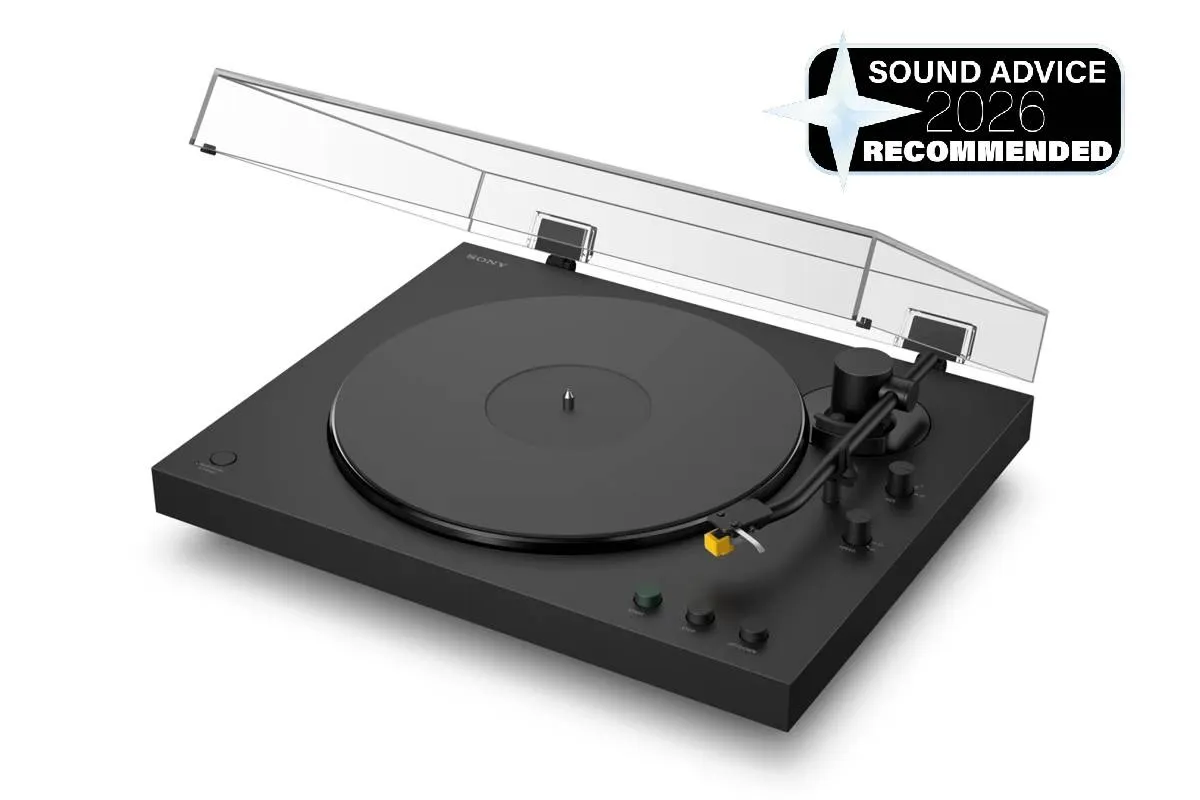
The PS-LX5BT (which from here on out I’ll be referring to as ‘5BT’, for the sake of both brevity and sanity) is about as thoroughly specified and equipped a record player as you can buy at any money. £399 put Sony’s way gets you fully automatic operation, a pre-fitted and pre-adjusted moving magnet cartridge, an integrated phono stage with three gain settings, and the analogue-to-digital conversion circuitry that’s required to allow the 5BT to transmit a Bluetooth signal to any Bluetooth receiver within range.
Not just any old Bluetooth signal, either. The 5BT is compatible with the aptX Adaptive codec (as well as plain vanilla aptX and ‘emergency use only’ SBC), which means it can transmit at a lossy 48kHz resolution to those devices equipped to receive it. Like I say, this is a thoroughly specified device. You even get gold-plated RCA connecting cables and a clear Perspex dust cover.
sound quality
Obviously the wireless aspect of the Sony’s specification is likely to be a big factor in any purchasing decisions, so I start my listening by wirelessly streaming to an Eversolo DAC-Z10 preamplifier - it can handle aptX Adaptive and confirms the signal is being received at 48kHz. And this proves a very enjoyable, as well as extremely easy, way to take what the 5BT has to give.
It’s an energetic, upfront listen that likes to get on the front foot as much as possible. Low-frequency presence is quite considerable - in fact, those who demand absolute precision where frequency response is concerned may find it just a little overstated - but there’s a fair amount of detail and variation to go along with the punch. And the Sony controls the bottom end pretty well, so it has no problem maintaining momentum and expressing rhythms confidently. There’s a nicely naturalistic flow to the way the 5BT sounds that makes good on one of the more common vinyl clichés.
The transition to the midrange is smooth, and there’s a similar level of detail identification and contextualisation going on here. This lets voices sound open and communicative, and allows details of character and attitude, as well as of timbre and technique, to shine through.
Things are not quite so successful at the top of the frequency range - although they stop well short of being any kind of fatal issue. There’s a relative lack of substance to treble sounds as delivered by the 5BT, a suggestion of flimsiness that’s at odds with the tonal characteristics of everything that’s going on beneath them. This is not a trait that ever threatens to top over into edginess or hardness, you understand - but it does serve to position the higher frequencies somewhat at odds with the rest of the frequency range.
Soundstaging is solid - there’s a nice spaciousness to the Sony’s presentation and it controls even quite complex, busy layouts well. And it has the sort of dynamic potency that means it can put a fair amount of distance between the quietest and the most full-on passages in a recording.
The 5BT doesn’t alter its character in any radical way when it’s connected to the preamp via the supplied cables and its phono stage is switched on. Gain is absolutely fine at the ‘mid’ setting, and while the Sony sounds identifiably itself, it is somehow more so. That slight lift in the lowest frequencies is a little more noticeable, the slight lack of substance at the top of the frequency range is just a touch more obvious. But having said that, by the standards of phono stages integrated into affordable turntables the 5BT has one of the better ones.
living with the Sony PS-LX5BT
‘Painless’ is as good a word as any to go with when describing life with the 5BT. Sony has done everything it can to take as much of the traditional hands-on turntable operation away from the user as possible, and has automated it instead.
That doesn’t mean there isn’t some work to be done in the first instance, of course. Once the plinth (which, at 3.6kg, feels rather unpromisingly light) has been taken from its packaging, you need to put the aluminium platter on the spindle and attach the drive belt to the motor pulley. You also need to attach the hinges for the dust cover to the rear of the plinth before fitting the dust cover itself.
After this, mind you, you’re on the home straight. Sony supplies a mains power cable that terminates in what looks very much like a USB-C connection - this needs to be plugged into the corresponding socket on the rear of the turntable. Here’s where you connect the supplied RCA cables, too, if you intend to hard-wire the 5BT to an amplifier - and here’s where you switch the phono stage on or off. Obviously your course of action here will depend on the amplifier you’re connecting to - but even if your amp has a phono stage of its own, it’s worth comparing and contrasting with the Sony’s. Especially as Sony has gone to the trouble of providing three gain settings for the phono stage, accessed via a little control near the ‘on/off’ switch.
If you’re using the 5BT wirelessly, there’s a button on the top of the plinth to initiate Bluetooth pairing. There are also buttons marked ‘start’ and ‘stop’, which either set the platter turning and move the tonearm into position or lift it off and bring the platter to rest. Before you use either of them, though, you’ll need to choose either ‘33’ or ‘45’ rpm and ‘7in’ or ‘12in’ disc size - the Sony is one of those rare automatic turntables that can happily play 12in 45rpm singles rather than making a song and dance about it.
The moving magnet cartridge is a) pre-fitted, b) pre-adjusted, and c) unbranded. Sony reckons the 5BT leaves the factory with a tracking weight of 2.0g (+/- 0.5g) dialled in, but my review sample is tracking at 3.13g - which is a little bit hefty but not exactly a catastrophe.
And in practice it all works very smoothly and reliably. The stop/start operation happens quietly and accurately, and Bluetooth pairing is the work of a moment (and the connection is solid and stable as long as your receiver isn’t a significant distance from the turntable).
conclusion
No, the Sony PS-LX5BT isn’t the last word in sonic fidelity - £400 or so spent on a more traditional turntable from one or two alternative brands buys you a little more where pure audio performance is concerned. But that’s not really the point, is it? The 5BT is a lively and engaging listen, and when you combine this sonic character with its huge operational flexibility and the utterly painless nature of the day-to-day experience, it’s very hard not to fall for its numerous charms.
listening notes
Mulatu Astatke New York - Addis - London
The vibes ain’t nothin’ but the vibes - and if there’s a more influential, more expressive master of the vibraphone than Ethiopian jazz titan Mulatu Astatke, I’d like to hear about it. The Sony’s ability to give a (mostly) natural reading of a recording’s tonality gets the once-over here.
boygenius the record
The direct and unaffected three-part harmonies that grant this album a lot of its charm are given complete and eloquent expression by the PS-LX5BT. It has plenty of observations to make about the attitude, as well as the technical ability, of the voices in question.
Funkadelic Standing on the Verge of Getting It On
On this album Funkadelic demonstrates its uncanny ability to be tight-yet-loose and loose-yet-tight all at the same time - which gives the Sony plenty of opportunity to showcase its facility with tempo and rhythm.
You buy a Sony PS-LX5BT because it offers a huge amount of convenience, along with no little sonic talent, at a very aggressive price indeed. Want a record player to slot into a full-size, entry-level system? That will connect wirelessly to any Bluetooth receiver and then serve up a stable and high-quality stream at basically no effort whatsoever? Here it is…
By the standards of turntables, the PS-LX5BT is a very flexible and adaptable device. Its integrated phono stage means it can easily connect to pretty much any integrated amplifier you care to mention (the WiiM Amp would be a great fit, thanks to both its line-level stereo RCA inputs, its Bluetooth connectivity and its abilities as a network streamer), and it can also connect wirelessly to speakers like the JBL Authentics 500 or headphones like the Px7 S3 by Bowers & Wilkins.