Award winner
Find at
Winner! Best of 2026: Headphne amplifier/DAC

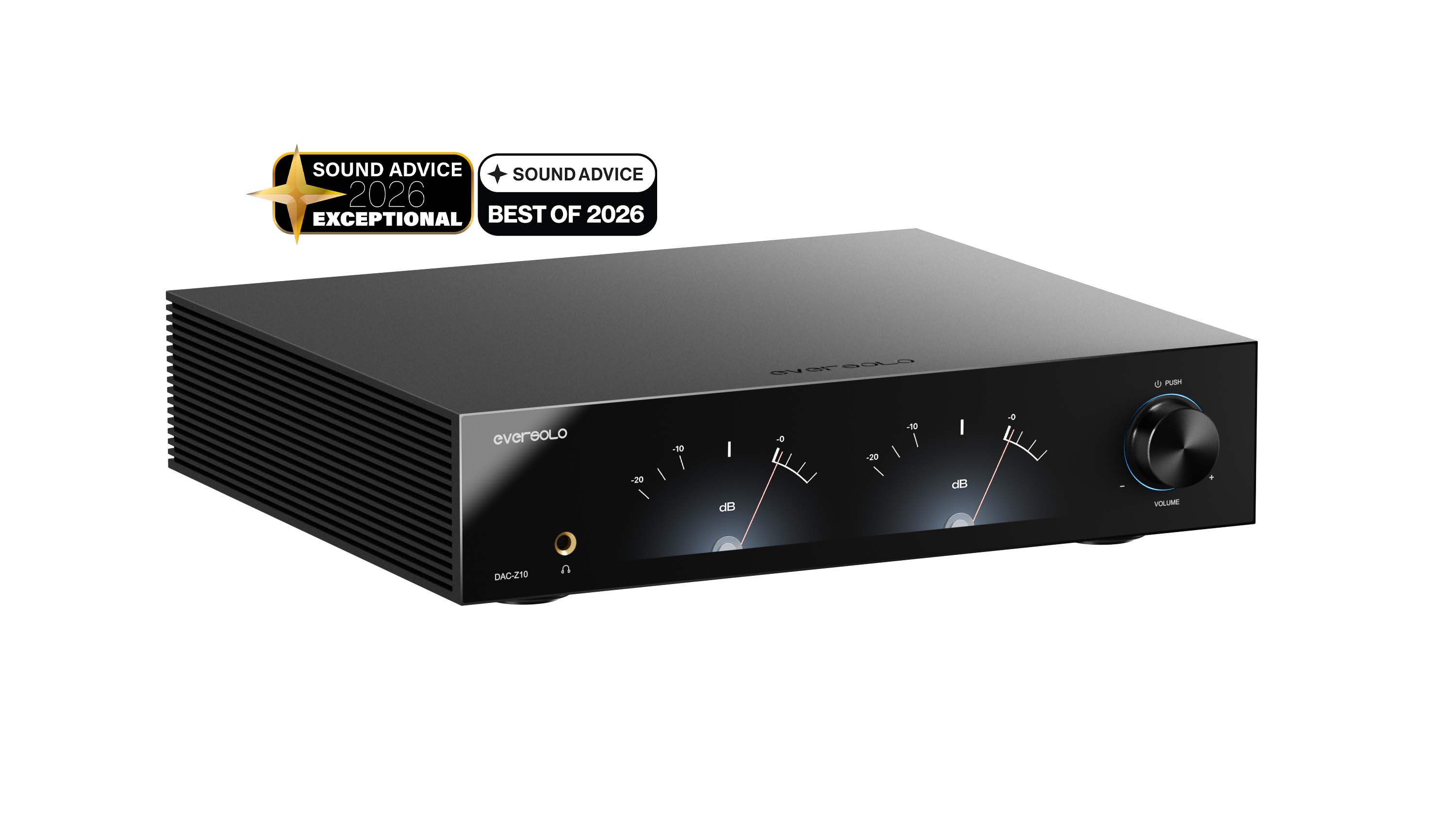
Having established that no area of the digital audio market is off-limits, Eversolo is now busily filling in those gaps in its model line-up where its nominal rivals would seem to have the upper hand. This DAC-Z10 preamplifier/headphone amplifier/digital-to-analogue converter is just the latest example of the company’s determination to reach digital audio ubiquity.
On investigating the DAC-Z10’s spec-sheet, I realise I’ve been using the word ‘thorough’ incorrectly all along. Or maybe ‘thorough’ is just too weak a word for the way Eversolo has gone about creating the DAC-Z10 - because if there’s a weakness in the way it’s been specified, it has completely eluded me. And I’ve been looking hard.
On the inside, Eversolo’s ‘Fully Isolated Architecture’ ideology is hard at work - the commitment to isolation, at every possible point, is approaching the fanatical. As regards the crucial business of digital-to-analogue conversion, for instance, there are a pair of dedicated AKM DAC chips (an AK4191 and an AK4499) for each channel - the left- and right-channel signals are kept completely separate from each other, all the way from input to conversion. Volume control utilises independent R2R ‘ladder’ modules for each channel, in a drive for absolute signal integrity even if the volume selected is very high or very low. There are three linear power supplies - one covering the left channel, one the right channel, and the third taking care of the system circuitry. And sure enough, they’re each carefully isolated from the other.
Then there’s Eversolo’s ‘Precision Core’. The clock system is a crucial part of any digital audio device, and the DAC-Z10 features FPGA clock reconstruction on the end of a system featuring a temperature-controlled crystal oscillator and phase-locked loop technology - which for most users represents more-than-adequate attention to detail. But Eversolo has also included an input for an external clock, one with multiple impedance settings - so integrating the DAC-Z10 into a system so high-end that it has clocking that’s even better specified than this is no problem.
There are numerous ways of getting audio information on board in order for the DAC-Z10 to do its thing. Digital inputs consist of an IIS input (capable of dealing with digital audio resolutions of up to 32bit/768kHz PCM and DSD512 featuring no fewer than eight switchable modes), USB-B (with multi-core audio processor and again supporting 32bit/768kHz PCM and DSD512), HDMI eARC , a fully isolated AES/EBU input, and a couple of pairs of coaxial and optical audio inputs (all four of which support 24bit/192kHz PCM and DSD64). There’s also wireless connectivity via Bluetooth 5.0, with SBC and AAC codec compatibility.
There are a couple of analogue inputs, too - a balanced XLR and unbalanced RCA equivalent. This is very handy, of course, given the DAC-Z10’s abilities as a preamplifier - and there are corresponding balanced and unbalanced outputs for connection to a power amplifier, active speakers or whatever else you’re using at the front end of your system. There’s a further analogue output in the shape of the single-ended 6.3mm headphone socket on the fascia - by this point you won’t be staggered to learn the headphone amplification module is kept completely isolated from everything else inside the Eversolo. The headphone input will automatically detect the impedance of your headphones and adjust its gain output accordingly - which is nice.
sound quality
There’s plenty to enjoy and quite a lot to admire about the way the Eversolo DAC-Z10 goes about every aspect of its business - but what’s most striking, at least initially, is the amount of detail it can identify and reveal in a recording. No matter how minor, or how fleeting, an occurrence in a recording might be, the DAC-Z10 will tease it out and offer it for your inspection. Not in any kind of showy way, either - simply as a way of ensuring you’re getting as complete a picture of your music as possible.
It has nicely even and undemonstrative tonality, no matter the filter setting you prefer, so the overarching flavour of a recording comes through with minimal interference. The DAC-Z10 is able to preserve the frequency response of the source device it’s handling too - in both of these respects, it seems more than willing to get out of the way of both your source of music and the music it’s playing.
It shapes and controls low-frequency activity well, so there’s a sprightliness to its presentation - rhythmic expression is good, and momentum levels never dip (unless the music insists on it, of course). The remarkable attention to detail translates to an articulate and revealing midrange, one in which voices are delivered with an absolute stack of character. And there’s a bright, but never unruly, level of attack to the top of the frequency range, where treble shine is carefully balanced out by a fair degree of substance.
Dynamic headroom is considerable, so even the most significant shifts in attack or intensity are described faithfully, and those extraordinary powers of detail retrieval I’ve already mentioned mean that no harmonic variation is too muted or transient to elude the DAC-Z10’s attention.
Really, about the only thing you must be careful of when considering the Eversolo is the management of your own expectations. The DAC-Z10 is capable of punching well above its weight in system terms - even quite expensive source equipment, pricey power amplifiers and high-end loudspeakers will feel the benefit of its expertise. But it’s not about to make a bog-standard pair of powered speakers into the system of your dreams - in fact, it’s more than willing to expose the limitations of equipment that isn’t similarly talented.
living with
The way the Eversolo DAC-Z10 is built and finished is every bit as impressive as its specification - and the company has gone to some lengths to ensure the user experience is as painless and, at times, fun as it can be.
The casework is more compact than the hi-fi separates norm - it’s 88 x 310 x 365mm (HxWxD), built from what is described as ‘aircraft-grade’ aluminium and finished in a manner that’s quite easily described as ‘impeccable’. Even the powder-coat finish to the casework is mildly tactile.
At the front of the box there’s a bright, crisp 8.1in IPS touch-screen display. It’s big enough to be able to comfortably display a great deal of information about input and output details, signal path and what-have-you without looking in any way crowded. And as well as technical info, it can also show your choice of a number of different virtual VU meters or dynamic spectrum displays. Even the single ‘turn/press’ control dial alongside it can be illuminated in one of numerous different colours. ‘Pinky Sky’ is my favourite, but you may have other ideas.
There are other control options beyond that touch-screen, too. The DAC-Z10 is supplied with a weighty, tactile and appropriately upmarket remote control handset that covers off the majority of the major functions. And while the ‘Eversolo Control’ app may be among the most visually unexciting apps around, it is thorough, stable, easy to navigate and responsive - which goes a long way for making up for its relatively humdrum appearance.
The end user even gets a little say in the way the DAC-Z10 performs. Each input can have its volume level specified, and every digital input can have a choice of six filters applied. The changes in sound they bring about aren’t exactly radical, but it’s nice to know Eversolo trusts its users at least a little…
conclusion
Eversolo is far from the only company that sets out with the best intentions when it comes to the specification and performance of its products. It is, though, perhaps the brand that is least prepared to accept compromise during the course of a product’s development, and as a result is usually to be found there or thereabouts when talk turns to value for money. The DAC-Z10 is just the latest demonstration of this.
listening notes
John Cale & Terry Riley Church of Anthrax
In which two luminaries of the post-War avant-garde attempt to outdo each other when it comes to hectic or contemplative improvisations using a variety of instruments. The Eversolo’s ability to create and control a soundstage is given a thorough examination (which, naturally, it passes)
Horsegirl Phonetics On and On
There’s nothing new under the sun, of course, but Horsegirl’s passion for minimal indie of the spindliest kind is nevertheless thrilling in its commitment. The DAC-Z10’s ability to extract even the finest harmonic detail brings this recordinging vividly to life
The Cecil Taylor Quartet Looking Ahead
Understanding of tone and timbre, attention to attack and decay and, most of all, the ability to bring order to bear where chaos seems to have the upper hand are all tested very sternly indeed by this singular recording. Not for the first time, the Eversolo emerges victorious
You buy the Eversolo DAC-Z10 because you have a number of digital sources of music that would benefit from the staggeringly thorough attention this device pays to their performance; because you have a very capable power amplifier and/or pair of active speakers; because you enjoy a virtual VU meter. Mostly for the first reason, though…
Even quite capable CD players (such as the Arcam Radia CD5) struggle to match the the Eversolo’s digital-to-analogue conversion abilities - and while it’s disproportionately expensive in almost every way, the DAC-Z10 would not be outclassed if positioned ahead of the Linn Klimax Solo 500
%20copy%20(1).webp)