
Award winner
Find at
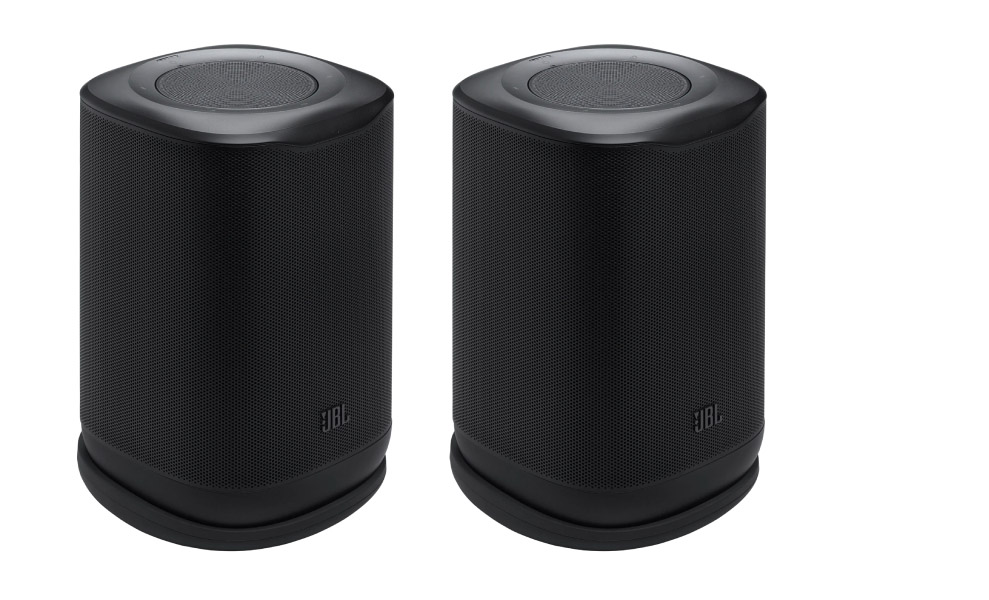
Seeing a rather bland-looking, black, cylindrical block of wireless speaker bearing the ‘JBL’ badge is almost as jarring as seeing catsuit-loving The Darkness frontman, Justin Hawkins, in jeans and a collared shirt (trust me, I've witnessed it).
The P1's earnest design is certainly at odds with JBL’s renowned wireless speakers, its fun, colourful portable Bluetooth models like the Flip and Charge. The US brand has clearly decided the P1’s more mature intentions, and indeed price, deserve a more mature look.
The new Cove range is JBL’s answer to Sonos; a whole-home Wi-Fi and Bluetooth audio system comprising the flagship, mains-powered X1 and two smaller models – the M1, and the larger, battery-powered P1 I have here.
The 3.0.1-channel speaker can be used independently or, as tested here, as a true stereo pair (when two are connected, obviously). This tethered configuration also allows them to act as rear surrounds in a home cinema setup alongside a compatible JBL Bar Series MK2 soundbar.
A P1 pair costs – gulp – pennies short of £800, for which you can get ‘proper’ hi-fi in the form of active stereo standmounts or budget separates. But proper hi-fi isn’t portable, nor is it typically as compact or extensively featured. Two P1 as a stereo pair, quite frankly, constitutes the epitome of system convenience. So does indisputable versatility justify not-insignificant outlay? Let’s find out…
SOUND QUALITY
The driver configuration inside each P1 resembles a set of stage lights – you have a front-facing 20mm tweeter and 105mm woofer, with three 30mm tweeters above firing upward at different angles, out through the top-panel speaker grille. That’s a big clue for one of the P1’s headline features: Dolby Atmos Music support.
Whatever side of the spatial audio fence you sit, feed the P1s a slick, well-mixed spatial audio file – from Amazon Music Unlimited, say – and they will dish up a good taste of what the technology is all about.
As expected from an implementation that sits closer to ‘diluted’ than ‘full strength’ on the Atmos delivery scale, the spatial sound is subtle - but it's effective. You get a noticeably taller and wider bubble of sound around the speakers than you do when playing stereo tracks, though naturally not the ‘sound all around’ impact that ‘proper’ multi-speaker Atmos setups can muster. By the standards of speakers of this type and price, the Cove P1 does good work with spatial audio content.
With good ol’ stereo music, the P1s still chuck out a reasonably big soundfield for the size of their enclosure and drivers, with a pleasantly surprising amount of weight and bass punch too. And you can sweep aside any worries that two ‘individual’ speakers paired wirelessly may lack cohesion - positioned between one and 1.5 metres apart, they sound nicely integrated, focus well and produce a solid soundstage.
Their visual identity carries into their sonic one: there's a maturity about the way the P1s present music compared to JBL’s cheaper, and wildly popular, Bluetooth models. You get more scale, for one, and greater space between instruments helps accommodate musically denser pieces and adds to the presentation’s overall coherence. It's a much more convincing description of music.
The midrange is particularly articulate – delightfully clear, textured and lucid – while bass notes are taut and well-defined, avoiding the hollowness that plagues many wireless speaker deliveries and with nicely judged presence that doesn’t upset the tonal balance. Its richness seeps into the higher frequencies, giving its overall delivery a pleasing warmth -though it does compromise high-frequency crispness just a little.
What’s missing is a bit of their Bluetooth siblings’ uninhibited musical flow. The P1s play it safe by opting for clarity and control over dynamism - and the Sonos Move strikes a slightly better balance in this respect. Meanwhile, the ‘lite’ version of the KEF LSX II stereo active speakers isn’t nearly as compact or flexible - but for not much more money, it's a more musical performer thanks to greater dynamic and rhythmic expression. Keep that in mind when weighing your priorities.
LIVING WITH THE JBL COVE P1
If imitation is indeed the sincerest form of flattery, Sonos should feel very flattered indeed. The P1 bears more than a passing resemblance to the Sonos Move, right down to the recessed cavity at the rear that constitutes a helpful carry handle and which houses a switch for disabling the microphone when it isn't needed for Alexa voice control or audio tuning. Such similarity isn't a bad thing: it’s smart, functional and, aesthetically easy to accommodate - an interior designer’s dream. It’s just not very ‘JBL’.
Where its design deviates most from that of its rival is the top panel, which is dominated by a circular grille through which those three upward-angled tweeters fire sound when fed a Dolby Atmos signal.
Bordering it are unremarkable and smaller-than-ideal touch controls for playback, volume, power and Bluetooth pairing, plus a very welcome shortcut function. Pressing that heart-shaped logo launches whichever shortcut you have set in the ‘JBL One’ app – ‘Spotify Tap’, which plays Spotify from where you left off, or a whimsical selection of ambient forest, rain, ocean or city sounds. Want more bird calls and fewer insect noises in your forest soundscape? Just swipe those adjustment sliders accordingly, just as you would with a traditional custom EQ (which incidentally is also offered in the app alongside four presets – ‘vocal’, ‘energetic’, ‘chill’ and the default (and best-balanced) ‘JBL Signature’).
If you dot multiple P1s around multiple rooms, holding that button instead brings the speaker into action and it starts playing whatever the other is. It’s all part of the convenience factor that lies at the very soul of whole-home systems like this, and it works. It has to, really - software can make or break a product like this. Without a smooth, reliable and intuitive experience behind it, the P1 would be as useful as an F1 car without wheels.
Fortunately, this isn’t JBL’s first rodeo, and whether it’s experimenting with EQs or stereo-pairing speakers, the experience is seamless. Not once in my weeks of testing does the app throw a hissy fit. The only gremlin I experience is the P1s occasional disappearance from the Google Cast list within the Amazon Music Unlimited app (but to be fair this also happens with my Bose speaker).
Next on the priority list for streaming speakers is compatibility with the increasingly long list of services and technologies that make the music streaming universe as progressive and competitive as it is. And again, JBL can only be praised here. Support for AirPlay, Google Cast and DLNA enables one-touch streaming directly from several native music service apps, as well as access to cloud-stored and local files from Google, Apple and NAS devices. Spotify Connect, Tidal Connect and Qobuz Connect are even better casting methods for those established services.
Some services are offered within the JBL One app, too, including Amazon Music, Tidal, Qobuz, iHeartRadio, TuneIn and Calm Radio, though the interfaces and user experiences aren’t nearly as satisfying as those offered by the native apps. Roon subscribers can – and likely will – opt for control within the Roon app. And even the newfangled Auracast is onboard for easily broadcasting audio to all compatible speakers.
Then there’s a JBL ‘special’: a proprietary technology that automatically tunes the speakers to their environment during the initial set-up of a P1, as well as when two are first stereo-paired. Not only is their room placement taken into account but also their proximity to one another.
That you don’t have to think about the proximity of the P1s to mains power outlets, as you do with most speakers of this size and price, piles on the practicality points. Each built-in battery is good for 14 hours - which I prove during testing at predominantly midway volume. The battery charges either using the supplied base that itself plugs into the mains via a 2.3m cable, or directly via the speaker’s USB-C port. A rubber flap conceals the latter to help give the P1 an element of water and dust resistance - it’s IP56 certified - which is handy if you decide to treat it to a picnic or garden party, for which its Bluetooth support is also handy. That single physical port also doubles as an audio input for MP3 playback, but only in the version sold in the US.
CONCLUSION
If you want it all – streaming, spatial audio, portability – the JBL P1 is a very decent example of the lesser-spotted breed of do-it-all, home-travel-hybrid speaker. That two can thrive as a stereo pairing makes it all the more appealing as a home’s primary music system.
Such jacks-of-all-trades often carry a compromise, of course - and here it’s a lack of rhythmic expression and nuance that the best-performing, albeit less impressively specified, wireless stereo speakers at this sort this money possess.
For convenience-conscious buyers, though, this could well be a small price to pay for exceptional flexibility. JBL will have to hope this the entirety of this consumer base hasn't already succumbed to Sonos.
LISTENING NOTES
Oh My God! It’s The Church (Where Did You Get Those) Shoes?
The P1s have the weight and bass punch to communicate the sonic splendour of the theatrical drum-driven, brass-laden instrumentation, as well as the midrange acumen to allow the retro-soul vocal to shine through with all the presence and campy pomp intended.
Oneohtrix Point Never Krumville
One of the tracks on the Again album that benefits most from having been remixed in Dolby Atmos. The height given to, and the opening out of the ethereal guitar loop, fragmented vocals and jagged synths only add to the fascination of this signature experimental electronica.
The Tallest Man on Earth Scully, It’s Me
Finger-picked acoustic strings and a raw, soaring vocal – it’s Kristian Mattson’s trademark pairing, and a glossy advert for the P1’s perceptive midrange. It has the texture and scale to capture the drifting melodies and reflective mood.
You buy a pair of JBL Cove P1s because you want a discreet and versatile modern stereo system that is streaming platform-agnostic, painlessly simple to use, and easily transportable from room to room or even beyond the home. That the speakers can be used in a home cinema setup in conjunction with a compatible soundbar, and can be untethered for individual use, further enhances their appeal for those who prioritise convenience and flexibility.
As a self-contained streaming system, the P1 needs only a phone, tablet or other source device to control music playback via Wi-Fi or Bluetooth. A subscription to a music service that supports Dolby Atmos streams, such as Tidal or Amazon Music Unlimited, will let you take full advantage of the speaker’s spatial audio capabilities. A compatible JBL soundbar could also connect to a pair of P1s configured as rear surround channels to create a modern home cinema system.


