Award winner
Find at
There’s ‘venerable’, and then there’s Goldring. The company has been in existence since 1906, and has been one of the planet’s leading manufacturers of turntable cartridges for the last 90 years or more - so ‘credibility’ is not something that’s in short supply here.
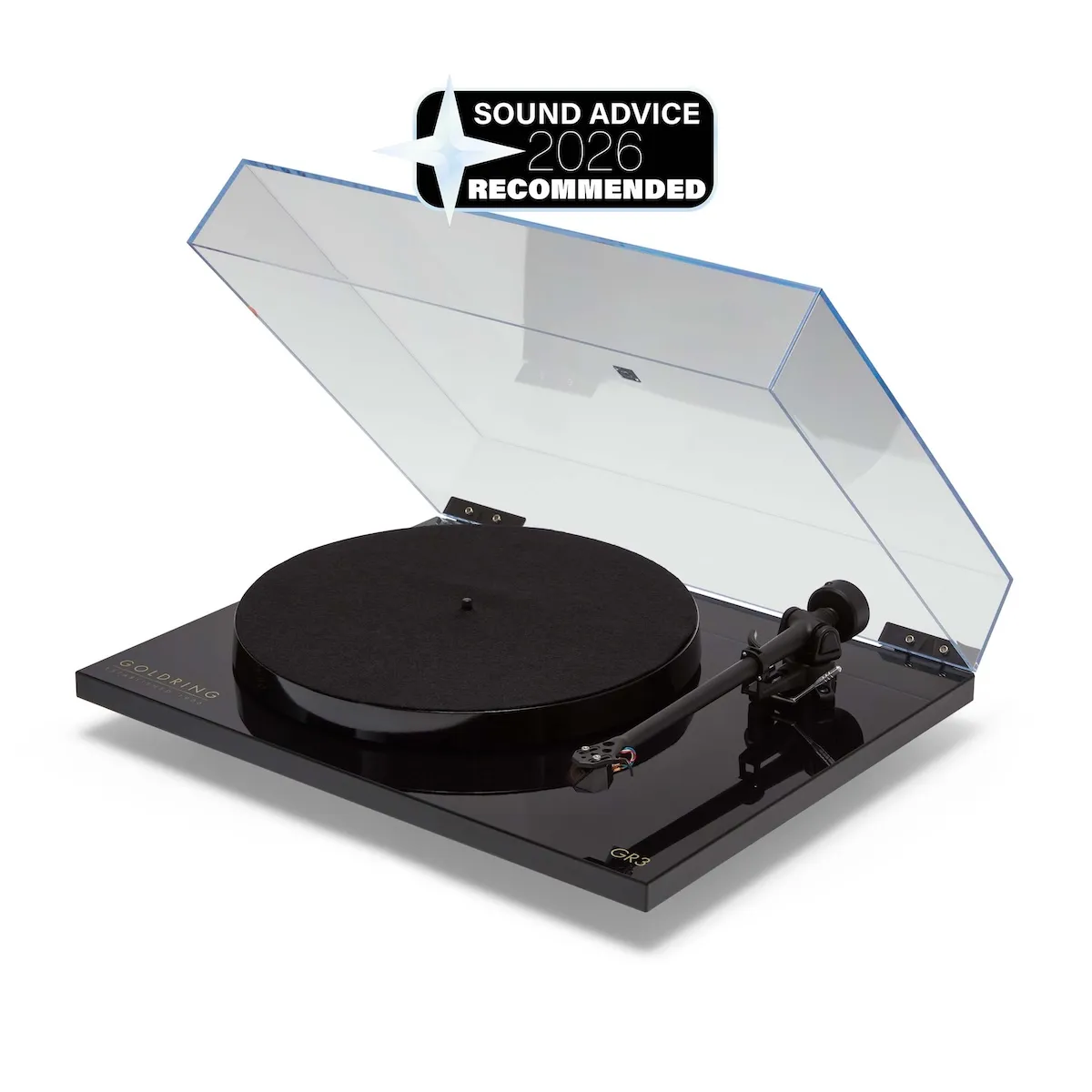
And it’s not something that’s lacking where this new GR3 turntable is concerned. It’s been 20 years since Goldring had a dog in the record player fight - so to make its return to the market as plausible as possible, it’s enlisted the help of one of the UK’s most well-regarded turntable manufacturers. Look at the detailing of the GR3 and you will find some clues as to its identity - and if you need more help, let me say ‘well-REGArded’ again, with a little more emphasis this time…
On the outside, the GR3 is 120 x 450 x 360mm (HxWxD) when its clear Perspex lid is closed over the anti-resonant composite fibre plinth - the plinth’s high-gloss black finish will thank you for keeping that lid closed as much as possible. It’s a belt-drive design with manual speed-change, and is fitted with a phenolic resin platter that’s designed to maximise the flywheel effect (and maintain consistent rotational speed as a consequence) by having the bulk of its mass on the outside.
The 237mm tonearm is a single-piece aluminium tube with a three-point mounting system. And it arrives with a pre-adjusted Goldring E3 moving magnet cartridge fitted - this is one of Goldring’s most successful and acclaimed cartridges, and its appearance as part of the overall package is very welcome indeed. And while we’re on the subject of worthwhile extras, the GR3 ships with a couple of pairs of interconnects by Goldring’s sister company QED - stereo RCA / stereo RCA and stereo RCA/ 3.5mm cables should ensure this record player can plug straight into pretty much any even remotely appropriate system.
The GR3 is also fitted with an ‘always on’ phono stage that amplifies its output to line-level before it is delivered to an external amplifier. This is a good thing, right? It means no system is off-limits, as long as it has a line-level input on a pair of RCAs or a 3.5mm socket. But because it can’t be switched off, anyone who already has phono amplification somewhere in their set-up will not be able to use it - which seems a slightly strange decision, to be honest. Although it seems unlikely it will be all that much of a deal-breaker for the majority of prospective owners…
sound quality
Very little in life is perfect, of course - and sure enough, the Goldring GR3 stops a little way short of perfection. But that’s not the same as saying it’s not a thoroughly enjoyable and periodically quite admirable turntable to listen to.
All of the things that record players are meant to do well, the GR3 does very well indeed. For instance, it has the most casually naturalistic way with rhythmic expression, and seems able to just flow through a recording in the most graceful manner. Its low-frequency presence is significant and solidly punchy, and has a whole stack of detail regarding texture and timbre involved too - but most of all it’s brilliantly controlled. The Goldring is absolutely impeccable in this regard.
Its facility with timing is also straightforwardly impressive. With the exception of the very top of the frequency range (which I will get to in due course), the GR3 reveals carefully neutral tonality and equally painstakingly even frequency response - and it is able to unify even the most complex, element-heavy recordings into a singular occurrence, a whole. This sense of performance and togetherness is often held up as one of the real advantages of a well-sorted vinyl system, and the Goldring has this facility in abundance.
And it’s no slouch in most other respects, either. It’s decently dynamic, so when the going gets loud(er) or (more) intense, those changes are tracked faithfully. It extracts a lot of detail from the groove, is able to contextualise even the most fleeting of it confidently, and always with the appropriate weighting. It’s able to create a large, properly laid-out and explicit soundstage - and every participant on it gets sufficient elbow-room. The midrange communicates in eloquent and unequivocal fashion.
Its overall attitude is positive and direct - it has an effortless way with rhythms and tempos, sure, but that’s not the same as saying it’s in any way laid-back or unengaged.
In fact, about the biggest criticism I can level concerns its relative lack of substance and consistency at the top of the frequency range. The highest treble sounds forgo the substance and body of everything going on beneath them, and they stand slightly to one side where tonality is concerned too. It’s a trait, really, rather than an outright shortcoming - but it does mean that system-matching is more of a thing with GR3 ownership than it otherwise would be.
living with the Goldring GR3
Goldring has done as much as is realistically possible to make the GR3 as painless to live with as it can be. And it’s been almost entirely successful in its efforts.
There are just a few things you need to take care of. The GR3 needs plugging into the mains, of course, and then it needs connecting to a system using one of the two supplied interconnects - to a line-level input, don’t forget. The E3 cartridge is pre-adjusted in almost every way - all you need to do is dial in the appropriate downforce (Goldring recommends 2g).
The motor that moves the belt that spins the platter is a low-noise, low-vibration design - and if you lift off the platter you’ll see the drive belt can sit in one of two positions on the spindle. Move the belt to achieve either 33.3 or 45rpm, and then put the platter back in place. The power switch is on the underside of the plinth, below where it says ‘Goldring - Established 1906’ on the surface. Set the platter spinning, lower the cartridge onto the vinyl, and you’re in business.
After that, there’s really only housekeeping to take care of. The black finish of the platter is as high-gloss as they come, and it is more than happy to reveal fingerprints and what-have-you. Keep your dust-cover lowered at every opportunity and keep a lint-free cleaning cloth nearby.
conclusion
Not so much ‘from nowhere’ as ‘from the dim and distant past’, Goldring has entered a wildly competitive area of the turntable market and delivered a contender with an absolute fistful of admirable qualities - convenience seldom sounds this good, great sound is seldom so easy to achieve.
listening notes
Reinbert de Leeuw Gnossiennes
This particularly elegant interpretation of Erik Satie’s greatest hit(s) allows the GR3 to showcase its unerring facility with rhythm and tempo, as well as its admirable tonal consistency
Los Campesinos! You! Me! Dancing!
A wild and giddy indie thrash that’s carefully organised and laid out by the Goldring - but, crucially, without impacting on its dynamic variations or general sense of abandon in the slightest
Angel Olsen New Love Cassette
The articulacy of the GR3’s midrange reproduction comes to the fore here - a less capable turntable can make the vocal sound vague and disengaged, but here it’s absolutely packed with character
Really, you buy a Goldring GR3 for its combination of great sound, admirable build and finish, completely painless plug-and-play convenience, and for its ability to slot into any system you care to mention. It makes a strong case for itself, if for no other reason than the fact that its nominal rivals can only claim some, rather than all, of these qualities.
That integrated phono stage means the Goldring GR3 is as adaptable as a record player ever gets. So connecting it to a pair of JBL 4305P via the speakers’ 3.5mm analogue input is every bit as valid as sending the turntable’s preamplified signal into a streaming amplifier such as the Technics SU-GX70 before it’s sent on to a pair of speakers.