Award winner
Find at
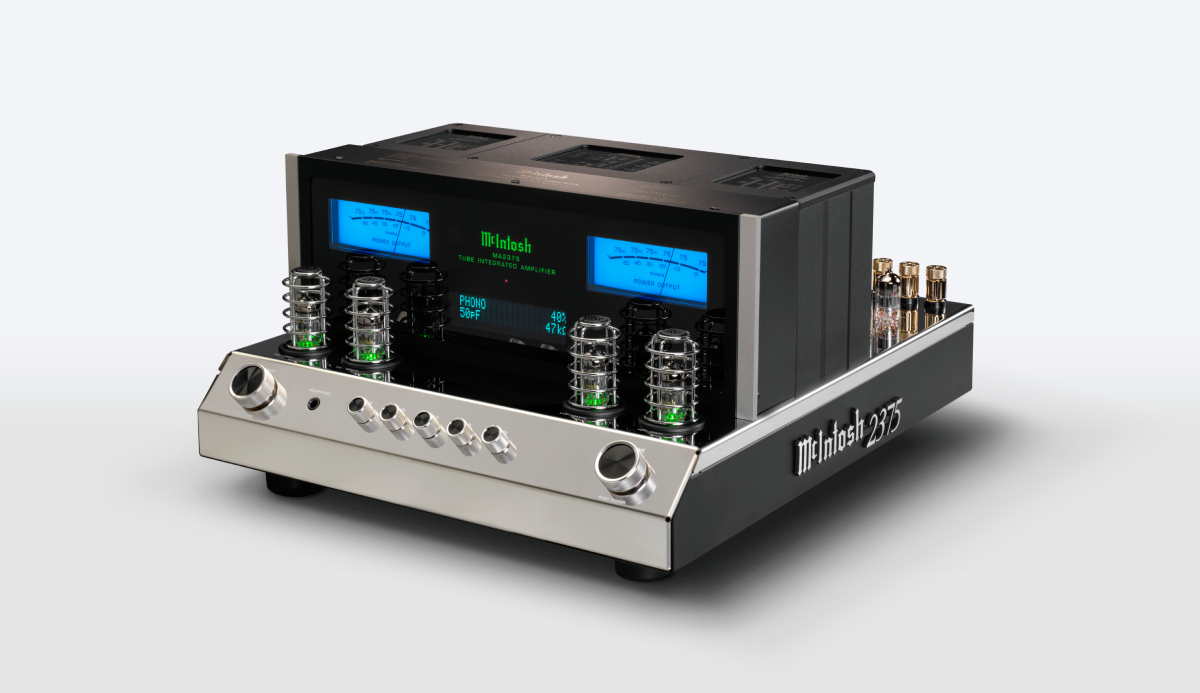
You don’t need me to tell you that these are uncertain times - but you can, at least, rely on McIntosh. You know where you are with this company, don’t you? The elaborate company logo, the glowing blue meters, the absolute fetishisation of vacuum tubes, a non-more-American preoccupation with the idea of physical scale... there’s a degree of reassurance about the MA2375 that I find very welcome.
The MA2375 is, according to its manufacturer, a ‘vacuum tube integrated amplifier’. It’s an all-analogue device, is built to deliver stereo sound, and is apparently the first new McIntosh vacuum tube integrated amplifier in over a decade.
Essentially, it’s a vacuum tube preamplifier and a vacuum tube power amplifier in one (ostentatiously large) enclosure. The power amplifier portion uses four KT88 output tubes and four 12AT7 driver tubes (inside a protective cage, so they can’t cause any burns or start any fires) that twist out 75 watts of power per channel via McIntosh's ‘unity coupled’ output circuit transformers. The preamp section deploys a couple of 12AX7A preamp tubes and a pair of 12AT7s too. Even before you consider sound quality, the visual effect is quite unlike that provided by pretty much any other manufacturer.
Obviously this arrangement is a little more complex and delicate than that of your more usual integrated stereo amplifier - so McIntosh has deployed some technology to keep the MA2375 from harm of both external and internal origin. The ‘power guard screen grid sensor’ (or ‘SGS’) technology monitors the current constantly and makes real-time adjustments to the input signal in order to maintain both tube integrity and sonic performance should the current become too high. ‘Sentry monitor’ short-circuit protection plays a role in keeping the MA2375 safe too - McIntosh wants you to understand it’s gone to certain lengths to ensure this device should prove more reliable over the long term than the delicacy of its headline technologies might initially suggest.
The rear of the MA2375 features quite a selection of purely analogue inputs and outputs. There are three unbalanced line-level inputs on stereo RCA connections, and two balanced alternatives using XLR sockets. Another pair of RCAs leads to a phono stage that’s switchable between moving magnet and moving coil, and it features discrete adjustment for gain, capacitance, resistance loading and RIAA equalisation. There’s a single pre-out for use with a subwoofer, an unbalanced pre-out on a pair of RCAs for use with a second amplifier (perhaps in a multichannel set-up), and eight of the company’s predictably overengineered ‘solid cinch’ speaker cable binding posts. In addition, there are ‘convenience’ features (such as ‘power control’ for synchronising with connected McIntosh components, ‘home theatre pass thru’ for integration into a multichannel system, an RS232 for use with third-party equipment, and data ports allowing source components to be operated from a common remote control) here too.
At the front, the MA2375 features a turn/push control that deals with input selection and also gives access to the device’s set-up menus (stuff like balance control, intensity of display illumination, specific phono stage adjustments and so on can be controlled here). There are five little controls for the analogue equaliser, offering adjustment at the 30Hz, 125Hz, 500Hz, 2kHz and 10kHz bands. There’s a volume control that also doubles as a power on/off switch, and there’s a 6.3mm headphone socket powered by a ‘high drive’ headphone amplifier that features McIntosh’s ‘headphone crossfit director’ (or ‘HXD’) which seeks to make headphone listening akin to listening on speakers.
sound quality
In terms of audio quality, the McIntosh MA2375 is many things but ‘understated’ is not one of them. Even though the way it performs never even alludes to the idea of effort, it somehow contrives to sound forward and forceful even when playing the most minimal and undemonstrative of music.
Anyone who’s heard a McIntosh product at pretty much any point in the company’s history will be primed to expect a sound that relishes the lower frequencies, and that’s the emphasis the MA2375 puts on recordings. The rest of the frequency range is fully represented, of course, and this amplifier is particularly adept when it comes to midrange resolution - but everything it does is built on big, sturdy and implacable foundations of bass.
The bottom end the McIntosh generates is full-figured, decently controlled, loaded with tonal and harmonic variation, effortlessly and solidly punchy, and is alive with information regarding texture and timbre. And there is plenty of it - though the MA2375 hits hard but with no little agility, and it expresses rhythms with something approaching certainty, the tilt towards the bottom end isn’t going to impress listeners who place proper value on an even frequency response. Those who find generous low-end presence exciting, though - and there are plenty of them - are going to find the way this amp serves up bass information very enjoyable indeed.
The midrange, as mentioned, is really well resolved and singers sound both naturalistic and characterful as a result. Detail levels are just as high here as they are at the bottom end, and there’s a positivity about the way the MA2375 shapes a vocal performance that leaves very little in doubt. This amplifier communicates in an eloquent and revealing manner, and the same is true at the top of the frequency range to only a slightly lesser extent. Treble sounds have more than enough substance - of course they do - but there’s a polite amount of crunch and bite to accompany it. And once again, detail and insight is such that stuff like the minutiae of transients is paid close attention.
The tonal balance is less overtly tilted than the frequency response, and anyone who subscribes to the clichés regarding vacuum tubes and toastiness may be in for a mild surprise. Yes, the tonality is on the warm-ish side of neutral, but not fatally so - there’s nothing like as much sonic heat here as there is physical heat from the power amp stage of the MA2375.
Its powers of soundstaging are impressive, and the control of the stage is such that its shape and definition is easy to understand. The spaces on it are kept clean and dark, too - and when it comes to big dynamic upheavals the McIntosh’s grip on the layout never falters. It’s a supremely unstressed device, and that’s never more apparent than when it’s putting a huge amount of distance between the quietest and the loudest occurrences in a recording. Mind you, ‘quiet’ is most definitely a relative term where the MA2375 is concerned - because, as I say, it never really steps down from its default attitude of front-foot, up-and-at-’em bonhomie…
living with the McIntosh MA2375
‘Big’ is too small a word to describe the McIntosh MA2375. There’s a reason hi-fi equipment racks are all more-or-less the same dimensions - it’s because the audio equipment they're designed to support is all of more-or-less the same dimensions. But on a regular Atacama Evoque Eco rack, the 252 x 452 x 519mm (HxWxD) MA2375 overhangs quite considerably at both the front and the rear - it stands on four feet, and my best estimate is that about 30 percent of each foot is contacting the shelf. Luckily the McIntosh weighs in at a mere 42.2kg - so if the worst should happen and the MA2375 falls from the rack that has proved more than capable of accommodating every other piece of audio equipment you’ve ever owned, at least the damage to your floor would only be ‘terribly serious’ rather than ‘completely catastrophic’.
Let’s assume, though, that you have a surface large enough and sturdy enough to accommodate the MA2375. The unmistakable aesthetic includes a generous amount of highly polished stainless steel, which admittedly looks the business right up until the moment you actually attempt to interact with the machine - and then it collects and highlights fingerprints like some particularly zealous scene-of-crime investigator.
You can control the MA2375 using the supplied HR085 remote control handset - it’s a system remote, which means it has more buttons than are absolutely necessary in this instance, and it could do with some backlighting. It’s really nothing special where look or feel is concerned either, which is a bit disappointing when you remember it’s in charge of a £17K amplifier. It’s quite logical in its layout, thorough, and getting what you want isn’t in any way difficult.
The controls on the machine’s fascia are similarly underwhelming. As with the remote control, it’s no kind of hardship getting the MA2375 to do what you want using them - but they feel profoundly unspecial and actually rather vague in operation. Neither of the user interfaces McIntosh supplies feels appropriate for use with a hugely expensive device like the MA2375.
conclusion
Both sonically and visually it’s a relatively strong flavour, the McIntosh MA2375, and it won’t be for everyone. But for those who value low-frequency assertiveness and sheer scale for the sake of it, and who have the necessary shelf space and the partnering equipment to calm, rather than compound, its excesses, this stereo amplifier is a good time waiting to happen.
listening notes
Four Tet Angel Echoes
The McIntosh’s absolutely implacable low-frequency presence is a given, but the relaxed forward motion of this recording allows it to demonstrate plenty of control and straight-edged precision to go along with the out-and-out wallop it is more than willing to summon
Rahsaan Roland Kirk Blacknuss
Celebrating the black keys of the piano in increasingly intense and frantic style, Blacknuss is one of those rare ‘jazz explorations’ that won’t have listeners running for the hills. There’s a warm analogue quality to this recording that suits the MA2375’s default tonality down to the ground
Cate Le Bon Pompeii
Her facility with the sneakiest of melodies - seemingly unremarkable at first, yet with the tenacity of the most persistent earworm - is to the fore here, and the McIntosh’s powers of midrange resolution allow the characterful nature of the vocal performance full and explicit expression
You buy the McIntosh MA2375 because you value full-on, full-fat and full-scale sound from any source with an analogue output - especially a turntable. You are also fully turned on by the unique aesthetic that’s on offer here, you don’t mind a control interface that feels like it came off the dashboard of a British car from the 1970s, and you have a surface both deep enough and strong enough to deal with the McIntosh’s baleful physical presence.
Visually, the Rega Naia is the exact opposite of the McIntosh MA2375 - it’s a slender scalpel to the amplifier’s diamond-encrusted sledgehammer. But the turntable’s tonal realism and absolutely forensic attention to detail will be complemented nicely by the amp’s thrust and substance - because sometimes opposites attract.