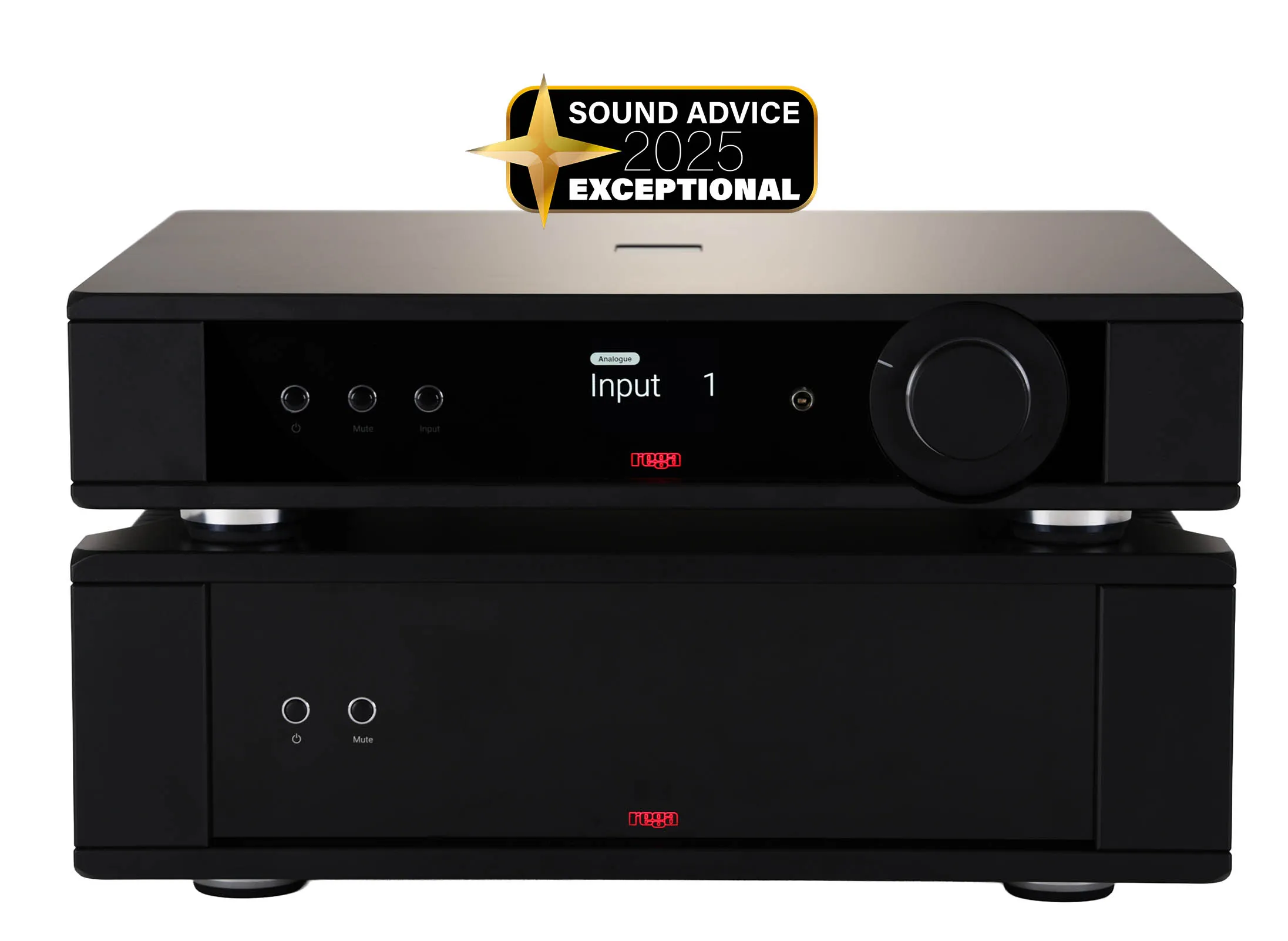
Earlier this year, I reviewed the Rega Brio Mk7, a Class AB integrated amplifier with a selection of analogue and digital inputs, smart metal casework and great sound quality, all for the pretty reasonable price of £799. In front of me now are the Rega Mercury and Solis pre- and power amplifiers - Class AB amplification with a selection of analogue and digital inputs, smart metal casework and great sound quality, all for the rather more eyebrow raising price of £13,900. What gives?
The short answer is that these two boxes represent everything that Rega knows about amplification, executed to the highest standard it knows how. For starters, this means it is split into two boxes rather than one, with the Mercury handling the delicate input signals and the Solis conducting the indelicate business of amplifying them. Quite a lot of amplifying, too - you get 168 watts into 8ohms and 305 into 4 (and, as I shall explain, this barely scratches the surface of the amount of heft on offer). From the carefully regulated power supplies to the six hefty output devices per channel, this is not an amp that leaves anything to chance.
The Mercury takes its responsibilities very seriously as well. It combines four RCA line inputs, one tape loop and a single XLR input with a digital board (built around Wolfson DAC chips, a rare choice in 2025) with two optical, two coaxial and one USB-B inputs. There are XLR and RCA preouts and matching inputs on the Solis, but Rega is adamant the pairing sounds better over RCA.
The hardware in the Mercury is less visibly hefty than the Solis, but it’s still extremely technically impressive. Some of the amplification stages use Linear Systems ultra-low noise FET (Field Effect Transistor) transistors in the differential quad pair input stages. You don’t need to understand (or care) what this means, but this is technology that first appeared in the Aura phono stage and it means the Mercury is quite astonishingly quiet in operation.
What’s very clever about all of this is that, if you happen to own a Brio Mk7 (or any other amplifier in the range) you can see that technology present in your amp (and doing a fine job) is still present in these flagships. It’s simply been beefed up and polished to a mirror finish. It makes these devices relatable to the rest of the Rega range in a way that some companies can struggle with.
Sound Quality
What if I told you that, despite the £13K gap between them, there are sonic similarities between these heavyweights and the Brio Mk7? Don’t worry, I’m not about to say that the culmination of everything Rega knows about amplifiers sounds exactly the same as an (admittedly brilliant) £800 product - but there are aspects of their behaviour that would leave a Brio owner completely at home with what these units are doing.
Of course, before the Brio owner comes to this conclusion they will revel in things that the Mercury and Solis can do that will be invigoratingly new. First up, there’s the power on offer here. I’ve tested more powerful amps than the 168 watts of the Solis but, unless you’ve got a ballroom on a remote Scottish Island in which to reach the limits of its reserves you’ll never get anywhere near them. This is effortless, imperious shove that makes your speakers sound like they’ve suddenly become 20% larger. The bass extension on offer here is genuinely outstanding and something rarely encountered even at this lofty price.
At the other end of the frequency response, the news is no less good. The Rega manages to balance some genuine top-end sparkle with tonal realism that is genuinely breathtaking at times. If I’m being at my most critical at this point, I’ll say the best results come from passing a signal through the Mercury rather than relying on the internal DAC board - but this is a decision reached by having digital sources on hand that cost more than the Mercury does. As a self-contained solution, it’s deeply impressive.
It's even better with vinyl though. Don’t forget Rega also makes the Naia (and the equally sublime Aura phono stage). Wiring that little lot up with the Mercury and Solis is likely to ensure the amount of time you spend listening to digital is very brief indeed. What’s consistently impressive (and maddeningly hard to describe) is that the Rega duo is astonishingly transparent - it’s able to reflect the character of the two different turntables in use here and yet still able to exert a character of its own.
And this character is where the Brio owner will find the family lineage. There is a refinement to how this duo operates that means that nothing in your music library is off limits. How they balance this with the detail and sheer presence they deliver as a matter of course is a secret I imagine that Rega is keen to keep to itself. Nevertheless, if you own any other member of the Rega family, you can rest assured the Mercury and Solis will still deliver the same attributes that won you over to the brand in the first place.
Living with the Rega Mercury / Solis
Unboxing these devices should not be rushed. I suspect even the Mercury might see you make an involuntary noise when you pick it up, but it’s a mere hors d'oeuvre compared to moving the Solis around - you will genuinely need to take care. They sit in a rack in a way that combines sobriety with purpose - they don’t shout their price but they make no secret of it.
They are still Rega products, though, which means once you’ve undertaken the calisthenics routine needed to get them in place they ask very little of you. Even less, in fact, than the more terrestrial amps. Thanks to a display and a remote control that allows you to directly select the input you want, the Mercury is convenience itself - and it has remote triggers to wake the Solis up and power it down too. Rega supplies superb cables in the box, and operation is entirely in keeping with more affordable designs.
There is a flexibility beyond their direct operation, too. The Mercury has the connectivity required to handle pretty much anything you’d remotely consider connecting to it and, for the vast majority of people who buy it, it will head off their need for a digital source too. For its part, the Solis allows for pretty much free choice where speakers are concerned. Rega has some defined ideas about how it would like you to use these units; it is adamant they sound better over RCA than XLR for example, but it isn’t so dogmatic as to insist you must use them this way.
Conclusion
In effect, what you see here is the ultimate expression of what Rega believes is important in an amplifier. The Mercury and Solis combine staggering performance with real world forgiveness in a way that makes it look easy when it really, really isn’t. They are masterpieces, and some of the very best of their kind.
Listening notes
White Lies Ritual
Remember when I said ‘nothing in your music library is off limits’? You can play the CD rip of this album which is musically great but has the dynamic range of a Tickle Me Elmo doll and somehow it’ll sound brilliant.
The Seatbelts Cowboy Bebop OST
You might think the soundtrack to a weird Japanese cartoon might be an unlikely source for an audiophile vinyl pressing but it is…and it gives the Rega pair the chance to show off their superb timing and dynamics balanced with gorgeous tonality.
Jack Savouretti Between the Minds
A sumptuous album of beautifully recorded, heartfelt tracks, this gives the Rega duo the chance to show off their ability to find the emotional content in a way that has you forgetting about the engineering and concentrating on the music instead.
If you are shopping at this stratified price point, the Mercury and Solis offer all the magic that well-engineered high-end gear should with a forgiveness and tractability that few rivals possess. If you want the amp you’ll use every day for the rest of your life, it’s made from these two units.
The Acoustic Energy Corinium look like a 'cheap' option for partnering these two devices, but their revealing nature and the fact they benefits from a bit of current delivery to really sing means that the end result is likely to be rather good.What the Corinium should do is maintain the Rega's detailed-but-tractable presentation and throw in speed and articulation all of their own. You can then use some of the money you've 'saved' by only spending six grand on the Acoustic Energy to go towards a Rega Naia - which is the front end that this spectacular combo really deserves.