Award winner
Find at
When I was very young, I became aware that, hidden behind an unassuming shopfront on a local high street, there was a place of musical magic. We used to pass it on car journeys to visit my grandparents, and my father would point it out and mention names of which I was just becoming aware: Clapton, Townshend, Page, Hendrix and more. It was only when I entered my teens and developed a penchant for rock and prog that I started to recognise the iconic ‘Marshall Stack’ of amplifiers and speakers behind top guitarists, and the way it made music become louder and louder.
Legend has it that, from being the proprietor of a musical instruments store, Jim Marshall developed the stack because guitarists wanted more power behind their instruments. It’s said that The Who’s bassist, John Entwistle, went to Marshall as he wanted to be heard over Keith Moon’s frenetic drumming, and then Pete Townshend did the same so he could cut through above The Ox’s newly boosted bass. And when This Is Spinal Tap created the legend of the Marshall amp that went up to 11, the company responded with models having volume controls running up to 20!
Anyway, that’s the back-story - and though Marshall may now be a Swedish company, the majority of which is Chinese-owned, some 66 years since founder Jim Marshall started his West London music store, it’s still in the guitar amps business. Oh, and home speakers, headphones, and home cinema speakers such as the Heston 200 subwoofer we have here.
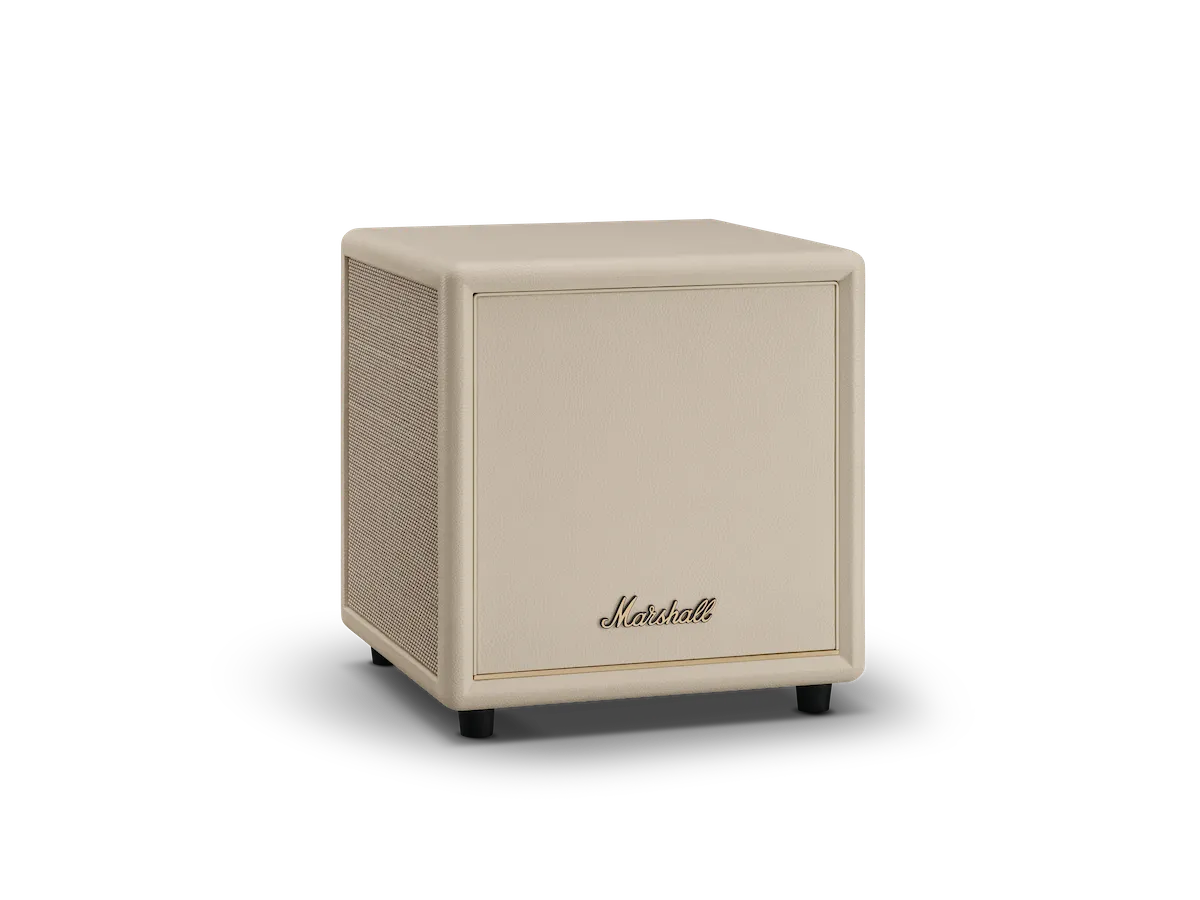
Why Heston? Why not Charlton? Blumenthal? The village down the road from Marshall’s original shop, and once home to the aerodrome that was the precursor of Heathrow? Maybe even the last M4 services before you hit London? Whatever the reason for the name, the looks echo the classic Marshall style, from the script badge on cloth grille to the rounded corners of the enclosure.
It’s hard to review the Heston 200 subwoofer without also considering it underpinning one of the company’s soundbars. After all it’s available in either black or cream, to match the Heston 120 and Heston 60 soundbars (the latter previously reviewed here), and while it will link wirelessly with either of those models, it also has a wired analogue input, suitable for use with conventional amplifier having a subwoofer output or pre-outs.
Marshall provides a Heston 60 for me to use with the subwoofer, but I am also keen to discover whether the sub can cut it when used in a stereo system - after all, this is a very compact unit, measuring 30cm or so on each side, and is fitted with two side-firing 13.3cm bass units, each driven by a 120W amp, and tuned with a reflex port.
The controls here are minimal, with just a volume control and a set-up button, making it dependent on Marshall’s own app when it comes to dialling it in. The app works with a wide range of the company’s speakers and earphones - here you press that set-up button on the back of the sub, and the app then allows adjustment of phase, upper frequency roll-off and level. The physical volume control on the sub – which disappointingly only goes up to 10 – can be locked out using that set-up button in case children or partygoers decide to see what the sub can really do.
And while Marshall’s publicity for the sub is suitably gung-ho – “feel the rumble that moves you” it says – with a bit of care in set-up, it’s possible to get that-all important low-frequency enhancement without the sub drawing attention to itself. Or at least as little attention as anything looking like a small guitar cab with that iconic logo front and centre can, anyway.
SOUND QUALITY
But there’s much more to the Heston 200 than just show. Yes, totally unleashed it will shake and boom the room, which is impressive for something so small, and fun for all of about five minutes. With a little tuning and experimentation using the app, the subwoofer becomes much more subtle in its contribution to the sound, while still making a valuable contribution – what’s more, positioning in the room becomes much more flexible when the sub isn’t making it clear where those low frequencies are coming from.
That valuable contribution is even apparent with speakers already having decent bass extension, such as the PMC Prodigy 5s I use extensively. The low frequencies simply have greater substance and impact, whether with rock, dance bass-lines or the lower ranges of a full orchestra. The Heston 200 brings a little more of a growl to massed double basses, and more punch to timpani.
However, it’s even more impressive when asked to stretch upward a little more to underpin small speakers such as the excellent DALI Kupid standmounters, at which point it creates that almost magical illusion of big-speaker bass coming from truly tiny enclosures. What’s more, it does away with that temptation to crank the volume up to make the speakers sound bigger, instead just adding effortless extension at sensible listening levels.
LIVING WITH THE MARSHALL HESTON SUB 200
As already mentioned, the size and adjustability of the Heston 200 means it can be used almost anywhere in the room and still do its stuff - for much of my testing it sits close to the equipment rack, with the main speakers placed across the room. With the level set low to compensate for the close position, it still pulls off that illusion of the bass coming from the main speakers. Considering their size, the little DALI Kupids are hardly bass-light speakers, but used with the Heston 200 they prove really remarkable.
However, will you want to hide the Marshall sub away? With that styling based on the company’s iconic guitar speakers, and the prominent logo, the temptation will always be there to have it on display. Hmmm – tricky one…
CONCLUSION
Marshall may not be the first name most audiophiles would think of when it comes to adding a subwoofer to their system – there’s always a hint of suspicion that this is simply a badge-engineering exercise. However, as Simon found out when reviewing the Heston 60 soundbar, and as my listening to this sub has proved, you overlook the brand at your peril. The Heston 200 is extremely good, being capable of both power and subtlety, and provided you can live with the upfront styling – or perhaps because you want to have it – it’s well worth considering.
LISTENING NOTES
Philip Glass Akhnaten
Glass’s Egyptian-themed opera opens with pounding drums and rumbling bass voices, and the Heston Sub 200is in its element reinforcing all this low-frequency stuff to dramatic effect
Benjamin Britten Storm
The fourth of Britten’s Sea Interludes from Peter Grimes is all about surging waves and orchestral power, and the weight and punch the Marshall delivers adds to the impact of the piece
The Who Pinball Wizard
Yes, a very familiar track -but listen out for the slam and growl of John Entwistle’s mighty bass that more than holds its own against Keith Moon’s manic drumming
There's a good chance you'll choose this sub over its price-comparable rivals simply because of the way it looks - but it's also a very sound choice for those who want some full-scale low-frequency impact from a less-than-overbearing subwoofer cabinet.
The obvious way to go is with the Marshall Heston 60 - this will give you home cinema sound that's way larger than the two speaker cabinets that are delivering it. But don't ignore the fact that stereo systems of all types can feel the benefit of what the Heston Sub 200 can do...