
Award winner
Find at
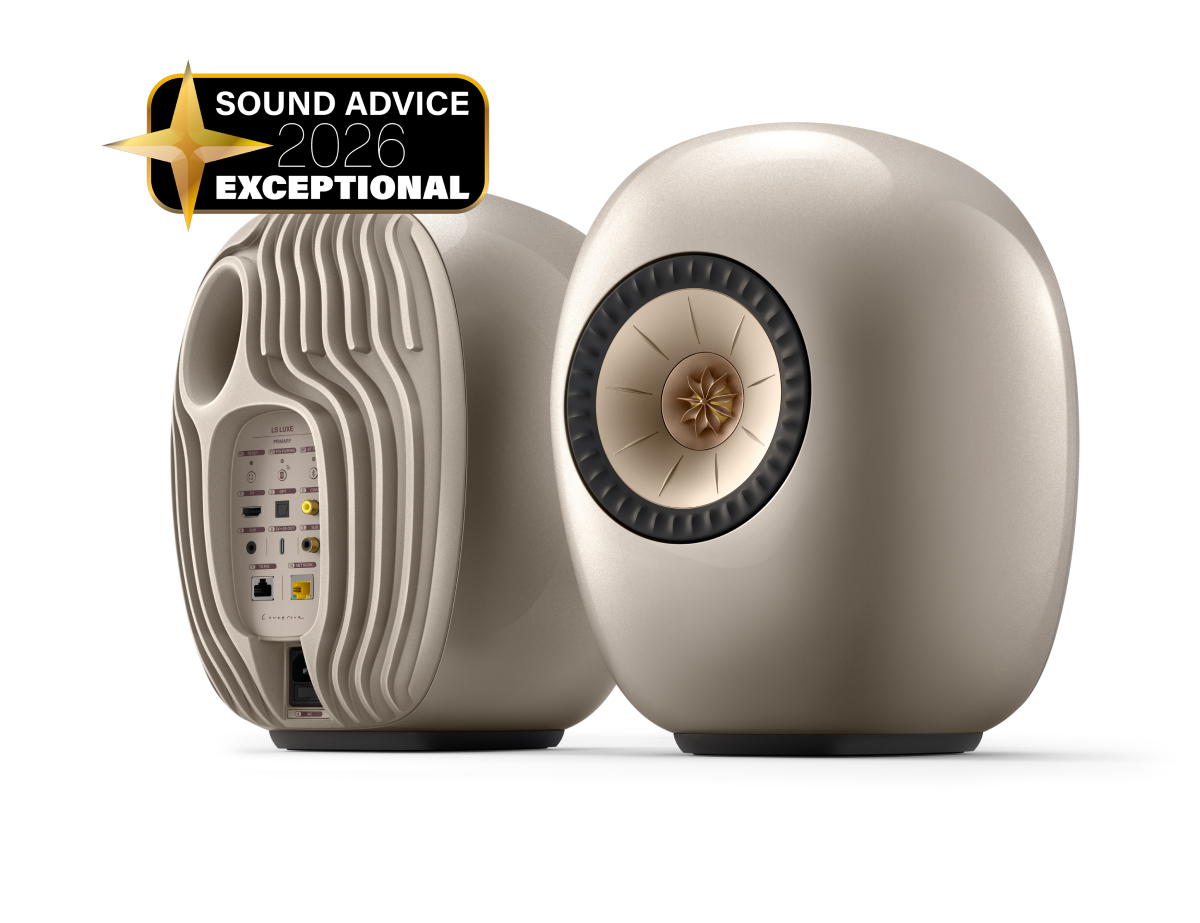
It may not have been the very first out of the blocks, but KEF was there or thereabouts when ‘active stereo speakers with network streaming smarts’ became a thing - and ever since, and at a variety of price-points, it’s remained one of the front-runners. Where stand (or shelf) -mounting systems like this are concerned, the company has had the sub-£2500 sector sewn up for some time now - so the new LS Luxe is designed to move the company’s credibility into a rather more rarefied part of the market.
It’s leaning on industrial design a little in order to do so - one look at the picture at the top of the review tells you as much. But it’s leaning harder on its established strengths, especially where technology and specification are concerned - the LS Luxe not only has an intriguing aesthetic, it most certainly has it where it counts.
For instance, the company’s ‘Uni-Q’ driver technology - which positions a tweeter in the acoustic centre of a mid/bass driver in order to offer superior driver integration and time-alignment - may be a dozen generations old now, but here it’s augmented by a much more recent KEF development. ‘Metamaterial Absorption Technology’ is positioned behind the 25mm aluminium tweeter, where it nullifies the energy moving backwards from the dome and offers purer, cleaner treble response as a result. That’s the theory, anyway.
The driver module here consists of that tweeter (behind its quite elaborate waveguide) in the throat of a 165mm aluminium mid/bass cone - the entire module is mechanically isolated from the cabinet it’s in, which should keep unwanted vibrations to a minimum. ‘Velocity Control Technology’, which I first encountered in KEF’s XIO soundbar, measures the bigger driver’s speed of movement and compensates for variations in the expected and the actual values. KEF’s ‘Music Integrity Engine’, meanwhile, aims to maintain tonal consistency no matter the volume level the system is being driven at.
There’s plenty of power available to drive this array, and of more varieties than you might be expecting - each tweeter is powered by 100 watts of Class A/B amplification, and each mid/bass driver is in receipt of 260 watts of Class D power. 720 watts really feels like an ample amount of poke, and the resulting frequency response of 42Hz - 28kHz also seems more than adequate.
As is established wireless stereo speaker system practice, there’s a boss and a subordinate here. The primary speaker takes care of all connectivity - the physical stuff consists of an Ethernet socket, optical and coaxial inputs, an HDMI eARC socket, and a 3.5mm line-level analogue input. There’s also an RJ45 socket for a hard connection to the secondary speaker, a USB-C slot for charging external equipment, and a pre-out for use with a powered subwoofer. Wireless stuff, meanwhile, runs to dual-band wi-fi (meaning there’s compatibility with the ‘Connect’ versions of Qobuz, Spotify and TIDAL, Apple AirPlay 2, Google Cast, UPnP and internet radio, with Roon Ready status due to be confirmed in the next few months) and Bluetooth 5.3 with SBC and AAC codec compatibility.
The LS Luxe can deal with digital audio resolutions of up to 24bit/384kHz PCM and DSD128 via any of its network inputs, can support 24bit/192kHz via HDMI and coaxial, and is good for 24bit/96kHz via the optical input. Connect the speakers together using the supplied RJ45-terminated cable and your audio information is scaled to 24bit/192kHz; this becomes 24bit/96kHz if you decide to connect the speakers wirelessly instead.
sound quality
The LS Luxe isn’t exactly judgemental, but it will make the difference between a hi-res stream of a recording and the same song sent via Bluetooth absolutely apparent. What never changes, though, is the system’s fundamental character. No matter the sort of music you like to listen to, and no matter how you get it on board the KEF in the first place, its character never falters. It’s always balanced, insightful, energetic and, above all else, entertaining.
Or, at least, it is if you spend a moment or two getting the speakers positioned just so. Every pair of stereo speakers relies on their positioning to a lesser or greater extent if they’re to be heard at their best - but the LS Luxe is definitely in the ‘greater’ camp.
The tonal balance is quite carefully neutral, and the KEF seems reluctant in the extreme to add or subtract anything by way of tonal temperature. It’s similarly judicious when it comes to frequency response - from the very top right down to the bottom, it’s balanced and more than willing to give every area the emphasis it requires. And at every stage, it’s approaching fanatical in the way it goes about identifying, revealing and contextualising detail both broad and fine. If there’s a wireless stereo speaker system that’s more adept when it comes to teasing out the finest details, I’ve yet to hear it.
This attention to detail extends to the dynamics of harmonic variation, which are described in full - and the broader, more obvious dynamics of volume and intensity are given full expression too. And when you combine this with the sort of low-frequency control that results in completely straight edges at the moment of low-end attack, the management of rhythm and tempo is confident and coherent too - and without sacrificing anything in the way of straightforward punch or drive.
Further up the frequency range the LS Luxe is articulate and direct where voices are concerned, and at the top end it has a kind of benign ferocity that makes treble sounds seem both bright and substantial at the same time. Crossover between the tweeter and the mid/bass driver is, to all intents and purposes, imperceptible - and this, along with the lovely even frequency response and the unified nature of the tonality, makes for a convincing and entertaining presentation.
About the only area where the KEF is anything less than startlingly accomplished is in soundstaging. The stage it creates escapes the confines of the cabinets, sure, and there’s absolutely no arguing with the discipline of the way a soundstage is laid out or the sensation of space between the performers on it. But where outright scale is concerned, the LS Luxe sounds just slightly constricted and doesn’t quite have the width or the height you might be hoping for. Don’t imagine, though, that this detracts from the overall experience in any meaningful way…
living with the KEF LS Luxe
The design of the LS Luxe is the result of another collaboration between KEF and Russ Lovegrove - and if you’re familiar with the previous fruits of this relationship, the curvily organic shape of the LS Luxe cabinets isn’t going to come as any kind of a shock. Neither is the fact that a KEF/Lovegrove product doesn’t look especially like any of its nominal competitors.
The almost pebble-like, edgeless shape of the cabinets is thanks to their being made from BMC (bulk moulding compound). As well as its willingness to form quite complicated shapes, BMC requires less internal bracing than a more regular MDF cabinet - so there’s more internal volume here than is the case with any boxy cabinet of similar dimensions. And that shape means the cabinet is less susceptible to the build-up of standing waves than it otherwise would be.
The rear of the primary speaker is where all physical connections are housed. Despite the fact the socketry is integrated into a fairly complex and visually striking aluminium heat-sink arrangement, it’s fairly easy to get at. It’s worth noting that each speaker has a fairly sizable bass reflex port that vents from the rear of the cabinet - this will have some input into your choices when it comes to positioning. It features KEF’s ‘Flexible Port Technology’, mind you - the pliant nature of the walls of the port and the minimal internal resonance that results, should mean the speaker is slightly more forgiving of its position than it otherwise would be.
And when you’re considering positioning, bear in mind KEF will sell you a pair of bespoke, matching ‘S-Luxe’ stands for a mere £799 a pair. No, they don’t do anything a decent pair of third-party stands costing half as much can do - but they are a very harmonious match for the aesthetic of the speakers, and that will probably be enough to seal the deal for some customers. The stands are supplied in a ‘Slate Grey’ finish, which KEF reckons will complement any of the finishes (‘Dusk Titanium’, ‘Mineral White’ and ‘Eclipse Black’) the speakers themselves are available in.
You can control your LS Luxe system in one of a few different ways. The metal-fronted remote control deals with the fundamentals of power, volume, input selection and what-have-you, will the ‘KEF Connect’ app offers more granular control. Here’s where you can integrate your favourite music streaming services, search for and store internet radio stations, do some rudimentary room-related audio calibration, check for firmware updates and so on. It’s hardly the most exciting-looking app, and it can take its sweet time on occasion, but for the most part it’s logical and stable.
conclusion
No, it’s not cheap - but sometimes you get what you pay for, and this is one of those times. With the possible exception of a phono stage The LS Luxe is very competitively specified - and between the looks and the sound, the KEF immediately establishes itself as one of the very best pound-for-pound wireless stereo speaker systems out there.
listening notes
Angel Olsen Shut Up Kiss Me
Proof that the KEF system can peer into a deliberately dense and foggy mix and return with all sorts of pertinent details. And having done so, it gives them all exactly the correct amount of emphasis and weight.
The Temptations Get Ready
This deceptively fierce cut by The Temptations allows the LS Luxe to show what it’s made of where rhythmic expression, midrange fidelity and straightforward momentum are concerned. It never lets that rattling Tamla Motown sound get out of hand at the top of the frequency range, either.
A Winged Victory for the Sullen We Played Some Open Chords and Rejoiced, for the Earth had Circled the Sun Yet Another Year
The KEF’s absolute mastery of tone and texture is given plenty of time in the spotlight by the exquisitely recorded piano here, and the system’s facility with harmonic variation is allowed to shine too.
You buy the LS Luxe because you want absolutely as much performance as a system of this type can give you, but you don’t want to spend properly daft money. If you like an interesting aesthetic at the same time, then you’ve already made a commitment to give KEF your cash.
Get yourself a subscription to a proper music streaming service like Qobuz or TIDAL and you’re basically in business. And if you want an authentic hit of vinyl quality, pair the Rega Planar 6 RS with a decent phono stage (Rega itself will sort you out, and Cambridge is no slouch either) and make a hard connection to that line-level analogue input.
.jpg)
