Award winner
Find at

You may recall Focal and Naim Audio merged back in 2011, a good few years before the first of Naim’s extremely successful and well-regarded ‘Mu-so’ wireless speakers came to market. The two companies have collaborated ever since, but this Mu-so Hekla ‘immersive home cinema system’ (which is categorically NOT the same as a soundbar, oh dear me no) is the most obvious indication of who is wearing the trousers.
Yes, strictly speaking it’s a ‘Focal powered by Naim’ product - but Focal considers itself the more credible brand where home cinema equipment is concerned, and so has co-opted the ‘Mu-so’ name, along with more than a few design cues, while serving up a big, expensive all-in-one speaker system. Naim is credited with developing the streaming and amplification electronics - which are important, of course, but not so important that the company gets its name anywhere on the product.
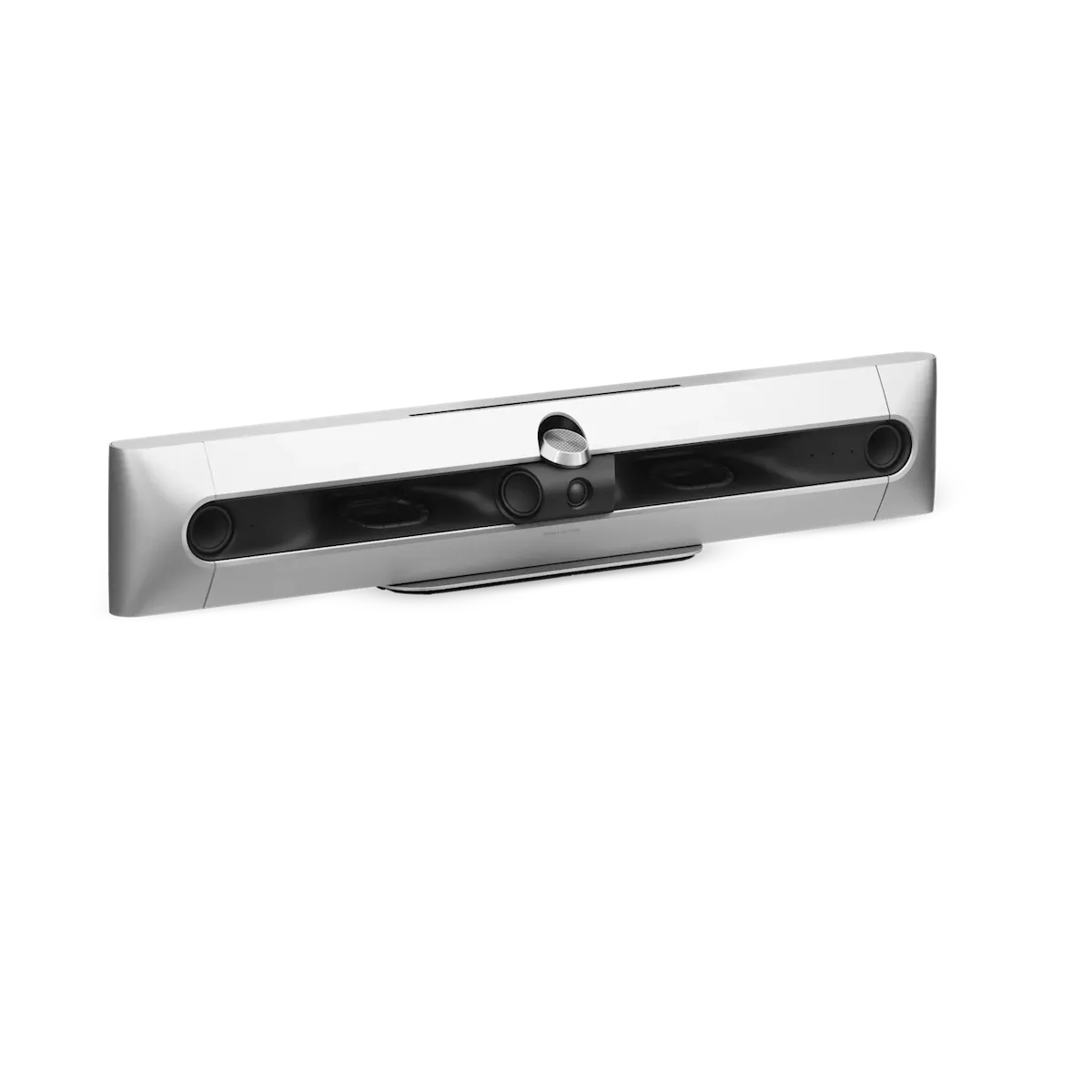
Inside the cabinet there are no fewer than 15 speaker drivers, each with its own block of Class D amplification and arranged to create a sensation of a 7.1.2 -channel spatial audio presentation. In the centre of the front panel there are three 130 x 60mm ‘racetrack’ bass drivers, and there is a 60mm midrange driver and a 25mm tweeter at either end. At each side of the cabinet, behind those perforated metal covers, you’ll find two 70 x 40mm ‘racetrack’ full-range drivers, and there are two more of these drivers behind each of the perforated metal areas on the top of the cabinet. The three big bass drivers get 60 watts of power each while the other dozen drivers get 40 watts each, for a total of 660 watts - Focal suggests it’s an arrangement that equates to a frequency response of 30Hz - 20kHz.
Getting audio content into the Mu-so Hekla in the first place can be done in one of a few different ways. Where wireless connectivity is concerned, there’s a courtesy implementation of Bluetooth 5.1 with SBC and AAC codec compatibility, and the rather more serious and useful provision for dual-band wi-fi 6. This means the Focal is UPnP-compatible, can work with the ‘Connect’ versions of Qobuz, Spotify and TIDAL, can access internet radio via Naim’s servers, and is compatible with Apple AirPlay 2, Chromecast, Amazon Music HD and plenty more besides. The device is compatible with every meaningful digital audio file type, and can deal with two-channel stuff up to 32bit/384kHz and DSD128 resolutions. Multichannel and spatial audio content can run at up to 24bt/192kHz.
Physical stuff consists of an HDMI eARC socket, a digital optical input that can function at resolutions up to 24bit/96kHz, and an Ethernet socket. There’s also a stereo RCA 'aux' out for use with, say, a powered subwoofer.
sound quality
From unboxing the Mu-so Hekla to having it set up and ready to play doesn’t take long at all, thanks in no small part to how intuitive and straightforward the Focal & Naim app makes the process. And once you’re up and running, there’s a whole lot to enjoy about the way the speaker goes about things.
When listening to music, there’s not a huge difference in the way the Focal goes about dealing with two-channel PCM content and the stuff that’s been mixed in Dolby Atmos. In either circumstance, it’s a cheerfully energetic and robust listen, able to dig deep into the frequency range and return with solid, varied and very carefully controlled low-end presence that hits with determination but never threatens to overwhelm the rest of the frequency range. The bass activity it delivers is rhythmically adept, thanks to good observation of attack and decay of individual sounds, and it gives a genuine sense of momentum to the music that needs it. There’s perhaps the slightest hint of overconfidence at the very bottom of the speaker’s extension, a little bloom that serves to showcase just how deep it can reach - but it’s easy to mitigate, if not eradicate altogether, in the control app.
It communicates explicitly through the midrange, and seems able to extract even the finest, most transient details from a vocal line and put them into the proper sort of context alongside the more usual details of tone, timbre and character. And at the top of the frequency range, there’s a crisp degree of attack that you might not automatically have been expecting given there are only two dedicated tweeters here. Treble sounds are substantial and bright, stop well short of becoming edgy even at volume (and never doubt the Mu-so Hekla is capable of significant volume), and carry just as much detail, both broad and fine, as the rest of the frequency range.
As far as soundstaging is concerned, the headline is that the Focal sounds huge. Yes, this is a very large speaker indeed - but the sound it delivers is larger still, and not only slightly. Its presentation expands well beyond the confines of the cabinet on the left/right axis, and it’s capable of offering a genuine sensation of the sonic height that’s basically the whole point of spatial audio content. No matter if you’re listening in ‘Sphere Music’ or ‘Dolby Music’ mode (and to be quite honest there’s really not a huge difference between them), the soundstage is large and coherent, with instruments and voices continuing to relate to each other even though there’s considerable space between them. And this is true of music that started life as two channels of information just as much as of music that has been specifically mixed for products like this - the Mu-so Hekla is generally (although not always) judicious when it comes to bringing its processing power to bear on two-channel content.
Switch to movie soundtracks received via HDMI and the good news not only keeps on coming, but it’s fundamentally the same as the news regarding music. The spaciousness of the soundtrack, the amount of detail the Mu-so Hekla is able to contextualise with no apparent effort, the punchily full-range response and all the rest of it are carried over intact. What a state-of-the-art spatial audio movie soundtrack makes much more apparent than the music equivalent, though, is just how much dynamic headroom the Focal has. Any blockbuster worth its salt likes to indulge in big shifts in volume and intensity, those moments when the near-silence transitions almost instantly to ear-splitting uproar - and this speaker breathes deeply enough to turn those moments into real ‘jump out of your seat’ events.
living with the Focal Mu-so Hekla
The Focal Mu-so Hekla is a not-inconsiderable 118 x 1000 x 295mm (HxWxD) and a similarly significant 15.5kg, but it hides its relative bulk well. The standard of build and finish is outstanding, and the liberal use of black aluminium (sand-blasted and anodised where it forms heatsinks at the rear of the cabinet) feels almost as good as it looks.
The overall design is reminiscent of the Naim Mu-so (2nd Gen) that launched back in 2019, right down to the large, smooth-scrolling control dial that’s been a feature of Mu-so models from the get-go. It’s a very useful and usable control interface, but to discover everything the Mu-so Hekla is capable of you’ll need to access the Focal & Naim control app that’s free for iOS and Android.
Here’s where you can select between your preferred spatial audio setting. The app offers Dolby Movie, Dolby Music and Dolby Night, as well as two alternatives developed by Focal - Sphere Music and Sphere Movie. The company suggests the ‘Sphere’ settings are better suited to rooms that enjoy some acoustic treatment, while the ‘Dolby’ settings lend themselves to spaces that are larger and/or less treated. No matter which of the settings you decide is best for you, though, each one can be adjusted using a three-band EQ and has ‘+/- 10’ sliders covering ‘height’, ‘surround’, ‘low frequency effects’ and ‘voice enhance’ - each of which is, hopefully, self-explanatory.
The app also features input selection, playback control, gives access to internet radio, allows the user to nominate up to five ‘favourites’ (radio stations, playlists, whatever you fancy really), run the ‘ADAPT’ room correction routine, adjust channel levels for each of the 10 channels in the 7.1.2 layout, check for updates, adjust the intensity of the lighting of the control dial, establish the Mu-so Hekla as part of a multiroom system (using as many as 32 partnering Focal and Naim streamers) and more besides. ‘Thorough’ is a good way to describe it, with ‘stable’ and ‘logical’ not all that far behind.
conclusion
You can argue all you like about what makes a soundbar a soundbar, and you can feel bad for Naim if you think the company has been marginalised in the way this latest ‘Mu-so’ wireless speaker has come to market. But there’s no disputing the fact that the Mu-so Hekla is the most complete and most convincing one-box spatial audio solution (quite a lot of) money can currently buy.
listening notes
Sinners Dolby Atmos soundtrack
There’s so much space throughout this soundtrack, and such attention paid to the placement of effects, that even a slightly sub-par rendition can seem ham-fisted and approximate. The Mu-so Hekla, of course, is neither approximate nor ham-fisted - it’s big and punchily energetic.
Cyberpunk 2077 Xbox One
The game may have stopped updating some time ago now, but its sound design remains one of the best around - and the Mu-so Hekla exploits every nuance and every effects movement to the absolute maximum
Neil Young Freedom Dolby Atmos mix
Reverse-engineering a late 80s recording to bring it into the spatial audio here and now isn’t always a great idea, but this Dolby Atmos mix by Young and long-time collaborator Niko Bolas demonstrates that it can be very effective if done carefully. The Focal brings a real sensation of space to the recording without making it sound remote or disjointed.
You buy the Focal Mu-so Hekla because you find the idea of a big, spatial audio-capable wireless speaker that categorically isn’t a soundbar appealing, because you take music as seriously as you take home cinema performance, and because you have plenty of the space the speaker needs in order to do its thing. Oh, and because you have plenty of money to throw at what is a pretty viable alternative to a multi-speaker cinema set-up.
Great video demands great audio - and the Samsung QE65S99H is certainly capable of delivering great images. Its sound, though, lags some way behind - but the addition of the Focal Mu-so Hekla will restore some A/V parity…