Award winner
Find at
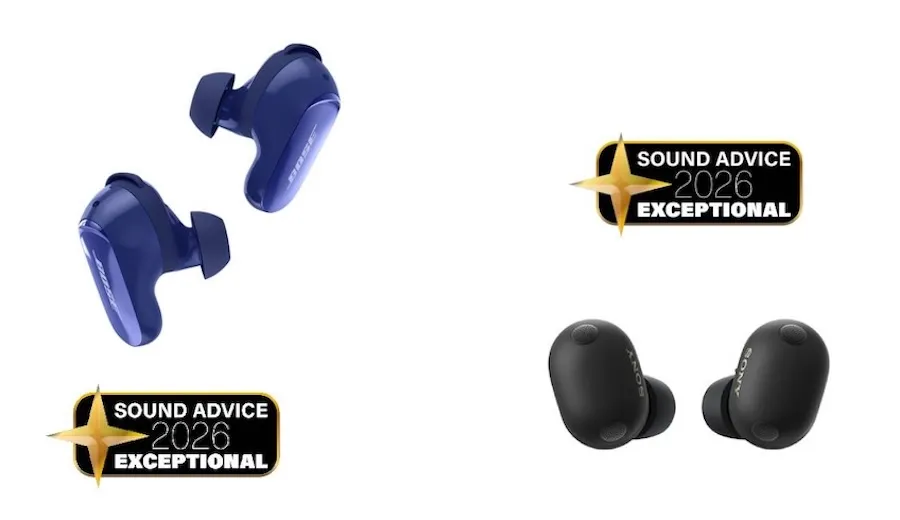
If you are looking for a new pair of wireless earbuds, there are a handful of brands that likely spring to mind, though perhaps none more so than Sony and Bose. Over years of iterations, these titans of the noise-cancelling headphones market have dominated best buy guides, and now Sony’s brand new WF-1000XM6 arrive hoping to follow that trend.
These earbuds come with promises for better sound, better noise cancellation and better battery life - impressive in itself, considering how much Sound Advice liked their predecessors. But how do they compare with our current favourite earbuds, the Bose QuietComfort Ultra Earbuds (2nd Gen)? I’ve spent hours with both of them, across planes, trains and automobiles, and so here I’m putting them head-to-head to help you decide where best to spend your money - the Bose cost £299 at launch, but are now down to £250, and the Sony cost the same (also £250) as the model they replace. Comparisons just don't get any more like-for-like...
Sound quality
In all honesty, there’s nothing that’s hugely revelatory here. You already know how much Sound Advice loves the Bose QuietComfort Ultra Earbuds (2nd Gen) from our review, and you won’t be surprised to hear that Sony hasn’t suddenly dropped the ball with its sixth generation of some of the most consistent wireless earbuds around, either. Both of these pairs of ‘buds sound great - but they do sound different, and which side of the fence you fall on this will be very much down to personal taste.
As Carrie-Ann notes in her Bose review, the brand is known for its punchy, full-bodied bass, and this character stands out strongly with these earbuds, particularly when compared with the Sony. There’s a greater emphasis on the lower register presence, delivering real depth and rumble to low-end notes – but that’s not to say it’s overpowering. Bose manages to put the brakes on that just in time, ensuring a rich sound signature that digs just about as deep as it can, while retaining detail and texture in the process.
By comparison, Sony’s tonal balance is much more even-handed and natural-sounding, though the WF-1000XM6 do seem to have paid a little more attention to that low end than the model they replace. Where Simon found the XM5 held back a little in the bass, the XM6 have a new driver that has dialled up the warmth and added back in some of the oomph - so there’s more authority here than with their predecessors.
The XM6 still sound very much like a pair of Sony headphones, though. That means a focus on accuracy, agility and articulation, with a tightly integrated presentation that handles complex tempos with ease. And all the while, detail retrieval is meticulous throughout the frequency range.
Clarity through the midrange is also beautifully handled by the XM6, and the result is that vocals have a touch more presence here than they do via the Bose - treble also extends further and is more refined, particularly towards top volume. That top volume is louder on the Bose, which is handy in very noisy situations - but for the last word in poise, insight and subtlety, I have to give it to the Sony.
Soundstaging is another area where the XM6 have the edge on the Ultra Earbuds (2nd Gen). Where the Bose sound a little more closed-in and intimate during normal listening, the Sony sound more open and expansive. This may well be a deliberate distinction, since the Bose have their ‘Immersive Sound’ mode as an option, which makes them much more expansive. This is Bose’s take on spatial audio, but instead of needing compatible tracks (both pairs of ’buds can play back Atmos-mastered tracks through those streaming services that offer it), the QuietComfort Ultra Earbuds (2nd Gen) can do it with any stereo music.
If that’s your thing, it’s one of the best modes of its type I’ve heard. It’s not without its quirks, and doesn’t work seamlessly with all tracks, but it’s something fun to play around with at the very least - and with the right tracks, can offer a genuinely impressive experience. The XM6 support Sony’s 360 Reality Audio, which offers a similar effect, but it’s only currently accessible through music three apps – and none of those are the main streaming services.
What the XM6 does do though, is give you more control over exactly how your music sounds, thanks to a new 10-band EQ (up from five-band on the XM5). By comparison, the Bose QuietComfort Ultra Earbuds (2nd Gen) only offer a much more basic three-band EQ, with a single control for tweaking each of treble, midrange and bass. That’s great for those who don’t know their way around an EQ, but does make it harder to get a more tailored sound, particularly if Bose’s more sculpted sound signature isn’t to your taste.
Living with Sony WF-1000XM6 and Bose QuietComfort Ultra Earbuds (2nd Gen)
An area where the Bose excel in this head-to-head is in noise cancelling – though Sony’s performance is getting better with each iteration. It has been helped this time round by Sony adding an extra microphone to each earbud, meaning they now match Bose's total of eight across both earbuds. This ultimately helps the earbuds to understand surrounding noise all the better, so it can more effectively cancel it out. Combined with the XM6’s new processor, Sony is promising a 25 percent reduction in remaining noise compared to the XM5.
That has meant that across low, rumbling transport noise, there’s now very little separating them. The louder top volume and more upfront character of the Bose does help to better mask any remaining noise that does make it through, though - and in more complex noise cancellation situations, like a cafe environment or busy street, the Bose convincingly pull ahead. Not only is the wind taken out of the general hubbub, but they also manage higher register noises more effectively – horn beeps and the chinging of cups and spoons are dulled more efficiently by the Bose, and it’s just an all the more convincing experience.
That also goes for the ambient mode, which sounds the most natural on the Bose too. It's hard to imagine being disappointed with the performance of either buds here, though.
Sony does have an interesting option that Bose doesn’t: Adaptive Noise Cancelling. This is a mode that you can switch on to have the earbuds understand what you are doing and automatically choose a level of noise cancellation to suit. You can customise these levels yourself or stick with the recommendation - and from my experience it works well at knowing what it is you’re doing, with no obvious step-change as it transitions through activities and noise-cancellation levels.
I also appreciate the rare ability to turn off all processing entirely with the XM6 – this is something the Bose don’t offer, and is actually increasingly hard to find. The sound is all the warmer with no processing switched on, and is bigger too.
Sony claims the XM6 offers its best call quality yet, but over several testing environments, callers consistently said I sound clearest on the Bose – though to what degree depended on the amount of surrounding noise that needed to be cancelled out. When noise-cancelling was at its most aggressive, that’s when the Sony earbuds struggled most, resulting in my sounding a bit muffled and unnatural. The only difference here is in windy conditions, where the Sony do a better job of counteracting it.
This may well be because of the Sony design, which fits all inside the ear, instead of the stem design of the Bose which leaves them a little more exposed to the elements. You’ll decide on the look you prefer, of course - but for comfort, particularly for longer listening, I have to choose the Bose. You can genuinely forget you’re wearing the Ultra Earbuds (2nd Gen), and I have happily worn them for hours at a time.
The XM6 are a little harder to forget. Not only do they require a little bit more heave-ho to get them where they need to be, sitting deeper into the ear, but once there, the squishy polyurethane eartips then expand to create a careful seal. While that’s great for noise cancellation and bass response, it does create a subtle-but-constant pressure against your ear canal that reminds you they’re there at any given time.
You do at least get four choices of eartips with the Sony for getting the fit as close as you can (XS, S, M and L), and while Bose offers ‘only’ three, plus a choice of three stability bands that help hold them in place, I still prefer the fit of the Bose.
The favour swings back towards Sony when it comes to the best battery life, though. That’s because you get eight hours of playback from a single charge, compared to six from the Bose – even though both have a total battery life of 24 hours including the case. Of course, unless you’re on a long-haul flight or running a marathon it’s unlikely that you’ll be wearing them for six or eight hours straight. So the real-world impact of those extra few hours is minimal when you’ll return them to a case for a small boost throughout the day.
As for other features, these buds are packed with as many as you might expect from each brand’s flagship true wireless in-ears – though you’ll have to download each buds’ companion app to access a lot of this.
Some features include Bluetooth Multipoint, high-resolution codec support (LDAC for the Sony, aptX Adaptive for the Bose), responsive touch- and gesture-based controls with customisable shortcuts, eartip fit checks, and some preset EQ settings. Both pairs of earbuds are also IPX4 rated, meaning they should be able to accompany your workouts and rainy runs without issue.
Conclusion
So which of the two, in this close-run contest, would I buy? Let’s say from the off that both are great pairs of in-ear headphones, and they are two of the very best buys in this category. So if you want the very best noise-cancelling, a supremely comfortable fit, great features and a rich, exciting and powerful sound, then the Bose are the earbuds for you. But overall, the Sony WF-1000XM6 edge it as the very best all rounders - they offer great noise-cancellation, have a longer battery life, and, with touches like Adaptive ANC and 10-band EQ, arguably offer a greater selection of more useful features. But it’s really in their musicality that they solidify their win, offering a more open, balanced and articulate sound that’s still plenty of fun.
Listening notes
Harry Styles Aperture
This bold, synth-heavy dance track leans into many of the Bose earbuds’ strengths, and they waste no time showing you exactly how much fun this track can be. The pulsing, looping bassline is warm, deep and textured, vocals are forward and packed with echoey detail, and keen rhythmic handling pushes the track along with toe-tapping urgency - the whole performance basically demands your attention.
The Sony are more even-handed, though they do keep the intended warmth from the distorted bassline - it’s just dialled down a notch. Timing is spot on here too - but there’s more adept handling of dynamics, so the textures of different synths and vocals are all the more explicit.
Gregory Porter Holding On
The simplicity of this track – just Porter’s voice and a small band – give the Bose the chance to show their softer side, and this slower tempo also allows them greater focus. The result is a deep, full-bodied vocal, with nice attention to detail across the instrumental and a thoroughly enjoyable, authoritative performance.
Porter’s voice benefits from more clarity and insight via the XM6, though, and it’s convincingly integrated for a more cohesive listen. There’s also more subtlety in the way the different instruments are handled, so you’ll notice the fade on piano notes lingers a little longer, and the different character and textures in the song are all the more clear.
System of a Down Toxicity
A chorus of thrashing guitars, crashing drums and screaming vocals sit in perfect harmony next to the song’s more melodic verses, and both pairs of earbuds manage this dynamic and tonal shift well. However, once again, the Sony simply translate this shift with a little more subtlety. When the song is at its most unhinged, the Bose go with it and they take you with them, enthusiastically air-drumming (or -guitaring, if that’s your preference) as you go. It’s full throttle, and it’s a whole lot of fun. It’s fair to say the Sony are a little more reserved in their handling of the craziness, and find their strengths better where the melody is a little more refined.
This is an easy one: you buy one of these pairs of true wireless earbuds becuase you want a combination of performance, comfort and features that simply can't be bettered at the price