
Award winner
Find at
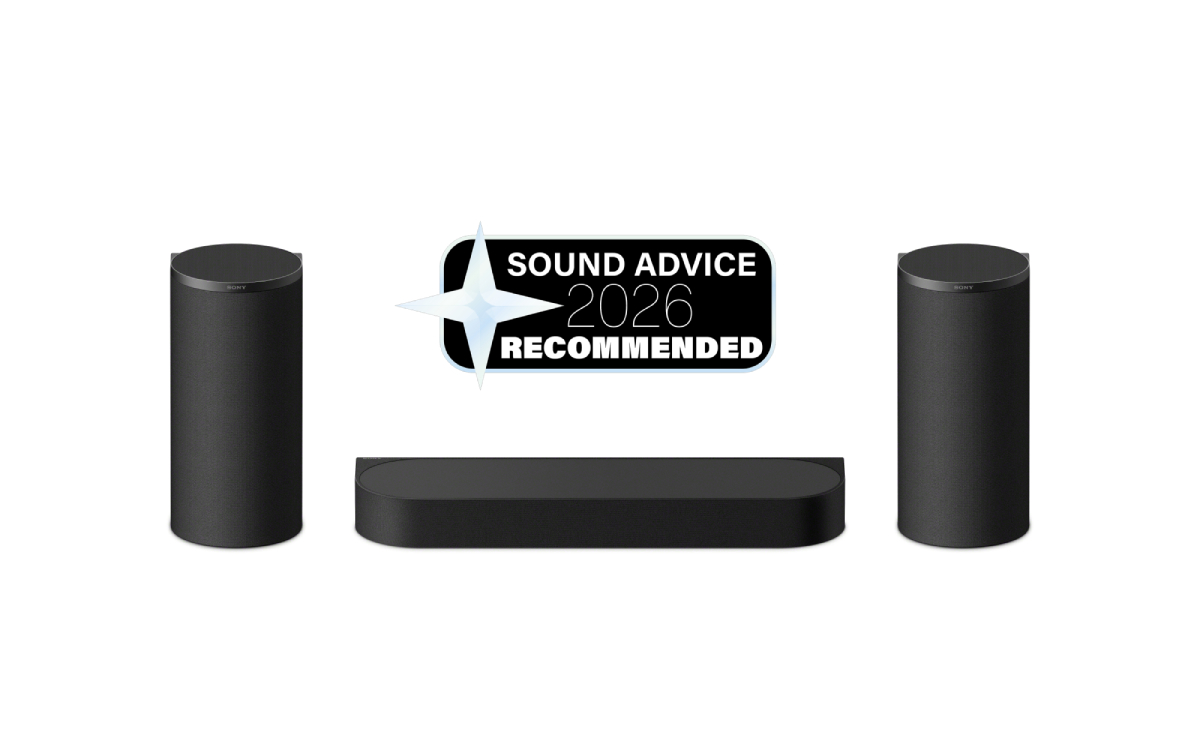
Sony’s home-theatre-in-a-box ambitions have long stretched beyond the realm of mere soundbars. With its 2021 HT-A9 surround-sound cylindrical speaker package and 2024’s distinctive Quad system, with its four flat speakers for low-profile wall mounting, Sony has shown a willingness to reach for the home audio high end with products that still tick the convenience box the soundbar market caters for.
Sony’s latest foray into this relatively rarified home theatre arena is arguably its most intriguing yet. For while the Bravia Theatre Trio might not boast the striking flat-speaker design of the Quad system, it’s a compact three-piece package specifically (though not necessarily exclusively) designed to accompany really massive screens, while using the latest version of Sony’s ‘360 Spatial Sound Mapping’ processing to create as many as 24 virtual speakers in your room for (hopefully) a truly immersive experience.
Sound quality
The Trio’s success, or otherwise, doesn’t just depend on the power and quality of its speakers. With only three components provided as standard (you can add other speakers, as I’ll discuss later), the ability of Sony’s unique ‘360 Spatial Sound Mapping’ processing to create believable, accurately placed virtual speakers for full-on Dolby Atmos and DTS:X playback will need to do some very heavy lifting too.
Happily, the 360 Spatial Sound Mapping system as applied to the Trio isn’t just good. It’s genius.
For starters, the huge scale of sound these three speakers can produce is remarkable. ‘Room-filling’ doesn’t really do it justice - it actually feels as if your walls and ceiling are being pushed out (in a very good way). The ‘ceiling’ part of that sentence is down to the Trio carrying maybe the finest up-firing speaker arrangement I’ve ever heard from a one-box speaker package.
It’s not just the scale of the Trio’s sound that impresses, though - there’s precision here too. For instance, the system can adapt its sound accurately and effectively to different location sizes, spreading wide for the airborne battles in Avatar and wrapping in tight for, say, the ultra-stressful flooding submersible scene in The Abyss.
Effects are placed with striking accuracy, too. So despite there only being three physical speakers, you can actually hear sound transitioning up and down, left and right and even, to some extent, front to back and all without any sense of ‘gapping’ as the sounds make their move. Transitions like this are the ultimate example of how the 360 Spatial Sound Mapping processing actually creates virtual speakers rather than just a general ‘wide soundstage’ effect.
Ambient effects and scoring both appear beyond the main on-screen sounds, while dialogue is locked to the screen. In fact, thanks to the way the system actually raises dialogue in the mix, it even sounds locked to a 85in screen (the biggest I can rustle up for this test). I have no doubt this will hold true with even bigger screens too.
Another aspect of the processing that makes the Trio tick is how much flexibility it permits when it comes to speaker placement. The main centre speaker should sit under the middle of your TV - but the ‘left’ and ‘right’ speakers can be placed in quite wildly different positions, if necessary, and still deliver a totally balanced, consistent and immersive sound (once you’ve run the Trio’s exceptional room calibration routine, anyway). This ability to adapt to almost any speaker positioning is arguably the single best thing about the Quad system - but if anything it’s even more impressive here, given it only has three actual speakers to work with.
The speakers are capable of maintaining absolute clarity without any hint of distortion at volumes far beyond anything most human ears will need - and they aren’t phased by any crazy escalating, multi-layered Hollywood denseness of the sort you get in, say, the famous song showpiece of Sinners. They just keep finding extra room to grow, no matter what’s thrown at them. The centre speaker easily keeps up with the left and right channels in terms of its power, projection and tone despite its small size and surprisingly lightweight construction. In fact, while the system is sensitive enough to still sound compelling, satisfyingly rich and detailed even at low volumes, the Trio just gets better the harder it’s pushed. Which is something Sony’s more regular soundbars don’t always seem tuned for.
Despite the grand scale of the Trio’s sound and its lovely rounded, harshness-free tone, it can still deliver hard impact sounds with great aggression and timing. The tonal balance also makes even Samsung’s mighty HW-Q990H sound a bit hard-edged with dialogue and some bright effects by comparison.
The Trio is also an outstanding music system. You have two options for playing back stereo music: no-nonsense two-channel playback using just the left and right speakers, or the ‘Sound Field’ option that essentially remixes music to take advantage of all the system’s speakers and channels. Both sound great.
The purist two-channel option creates a fantastically substantial, but beautifully controlled, soundstage capable of spreading across as big a space as you like without sounding forced, dislocated or incoherent. Detailing is impeccable - the tiniest details are revealed from the most complex of mixes with exactly the right weight and presence. No type of music causes the speakers to sound strained in any part of their dynamic range, with bass hitting clean, deep and hard without distorting or overwhelming anything else, treble sounding brisk and clear without becoming harsh or thin, and the midrange coping with any amount of instrument-layering drum/bass/vocal pressure - even at high volumes.
Stereo staging is immaculate, sounding cohesive and natural no matter how far apart the speakers are, and vocals are presented at the heart of the mix with total conviction and clarity. There’s a warmth to the presentation, too, that means listening to the Trio never gets fatiguing.
If you call in Sony’s ‘Sound Field’ option the sound profile shifts considerably - the left and right speakers focus more on spatial details and specific left/right steering effects, while the centre speaker takes a grip of vocals and a fair bit of the bass and lower midrange information. The resulting soundstage is certainly bigger, taking on a more vertical dimension that gives vocals a touch more prominence, but unlike many similar multi-channel ‘remix’ processes, Sony doesn’t try to push the sound expansion too far.
There are some minor limits, rather than actual flaws, with the Trio’s efforts. First, as things stand the 360 Spatial Sound Mapping is based on a pretty specific sweet spot. Shift more than a couple of feet sideways, back or forwards from this position and the (previously impeccable) balance of the soundstage is lost a little - so when you’re not watching a film by yourself, the other viewers will have to get nice and cosy to share the best sound. Sony says it’s investigating 360SSM options that cater for wider sweet spots, but there’s nothing solid to report on this yet.
While the dynamic range of all three speakers is remarkable for such compact designs, the most extreme movie moments can reveal a marginally ‘thuddy’ floor to their low-frequency response. But this only happens at truly extreme moments, and the effect is mild enough to barely count as a distraction. Even the infamously deep bass drops at the start of Blade Runner 2049 don’t cause any distortions or drop-outs. But I only experience a mild sensation of effects behind my seated position - I don’t get the same rear-effects punch and precision you might expect to get with a set of real physical speakers.
(Speaking of which, Sony actually provide me with a pair of its new, cost-option Bravia Theatre Rear 9 speakers to try with the core Trio set up, as well as the new Sub 8 cost-optional wireless subwoofer. These add £699 and £649 respectively to the Trio’s price, unless you’re prepared to wait until mid-July for the arrival of a discounted £2799 Trio / Rear 9 / Sub 8 package, but they also add substantially to the Trio’s already remarkable efforts. The Rear 9s, in particular, are seriously premium items, enjoying almost the same size and build quality as Trio’s left and right speakers. They deliver a seemingly exact tonal match, as well as the same level of detail and weight, and add a true rear component to the Trio’s epic sound stage. From the outside the Sub 8 looks like just a typical run-of-the-mill bass speaker of the sort you might find in a mid-range soundbar package - but the precision, balance, timing and intelligence it shows when attached to the rest of the expanded Trio package is actually pretty sublime, bringing another level of bass and heft to movie soundtracks and even music without ever leaving a gap between its sound and that of the lower mid-range of the other speakers. You can add two of these subs if you like, too, to make the system’s bass sound a little more non-directional.)
Living with the Sony Bravia Theatre Trio
Aside, perhaps, from the left and right speakers being quite chunky, everything about the system is designed to work with, rather than against, your room layout. The system does an incredible job of filling in the usual audio ‘gap’ the built-in sound-systems of king-sized TVs typically leave, despite the remarkably compact size of the central bar element - but the genius of its 360 Spatial Sound Mapping system enables it to do so much more than that. It will fill any room, no matter how awkwardly shaped, with beautifully coherent sound.
The 360SSM processing’s brilliance becomes even more apparent if you add a pair of Rear 9 to the sound - just as with the front speakers, you can put the Rear 9 anywhere where you want and still get a sound profile that will convince you there are speakers placed in the optimal position.
Sony’s thoughtfulness when it comes to the Trio’s flexibility even extends to a pair of little feet you can add to the bottom of the main bar component if it needs to sit across your TV’s feet, and the inclusion of a nifty little USB stick mic that plugs into your phone for an optimal room optimisation process.
Sony’s ‘Bravia Connect’ app has become one of the slicker, more useful apps for controlling AV gear, too, doing an excellent job of guiding you through the straightforward initial installation process and helping you add extra speakers should you desire. And the Trio ships with a cute little remote control - but with the main soundbar not carrying a proper LED display (just a few colour-coded lights), most users will typically prefer to use the Bravia Connect app.
In a perfect world, the Trio’s connections would include a second HDMI input. The HDMI pass-through system does import 4K @ 120Hz gaming feeds, though, as well as Dolby Vision HDR alongside the more basic HDR10 and HLG flavours. There’s no pass-through support for HDR10+ though - HDR10+ external sources revert to basic HDR10 instead.
Conclusion
It’s hard to express how much I love the Sony Bravia Theatre Trio. Its combination of beautifully rich, warm, immersive, effortlessly powerful and immaculately balanced sound (for both movies and music) and peerless room compensation system makes it a wonderful addition to any home cinema set-up. This is especially true for the king-sized screens Sony designed it for, but its appeal goes way beyond that specific demographic.
Its power and grace easily justify what on paper initially looked like a challenging price too, and it even offers a brilliant (if expensive) upgrade path.
Test Samples
The Greatest Showman 4K Blu-ray
The Bravia Theatre Trio is so good with both music and movies that you might as well let it rip on a modern movie musical with a thumping Dolby Atmos soundtrack. And anyone who tries to tell you this film is an OTT cheesefest can do one.
Overlord 4K Blu-ray
And don’t let anyone tell you Overlord is just a glossy B-movie, either. As well as being hugely entertaining in its own self-aware way, this zombie Nazi horror movie also boasts a rich Dolby Atmos soundtrack that’s done majestic justice to by the Trio. Especially the opening sequence, where explosions go off all around the exterior of the plane about to drop a bunch of unlucky soldiers into hell.
Blade Runner 2049 4K Blu-ray
Arguably no other soundtrack known to man (except, perhaps, some scenes in Denis Villeneuve’s recent Dune movies) goes out to create a more epic sense of scale, especially with its score, than Blade Runner 2049. Which makes it the perfect film for revealing the power, huge dynamic range and epic sound staging the Trio is capable of delivering in any shape of room.
The Trio system doesn’t just deliver outstanding movie and music sound quality. It also delivers outstanding movie and music sound quality in any room, no matter how awkward its shape or imperfect the position of the left and right speakers might be. The 360 Spatial Sound Mapping system that delivers this ‘good sound in any circumstances’ also does a spectacular job of creating virtual speakers in your room that deliver a much bigger and more detailed sound than you’d think possible from a three-unit system.
The Trio system is particularly designed to partner really big TV or projector screens, filling in that gaping hole in the soundstage you usually get with a giant TV’s integrated speakers. I’d argue that it’s a great partner for really any premium display though.
Sony’s Bravia Connect technology allows for enhanced interoperability between the soundbar and Sony TVs using just one remote, and the soundbar supports a couple of specific PlayStation 5 features over its HDMI pass through too, including automatic HDR optimisation and auto genre selection.

