
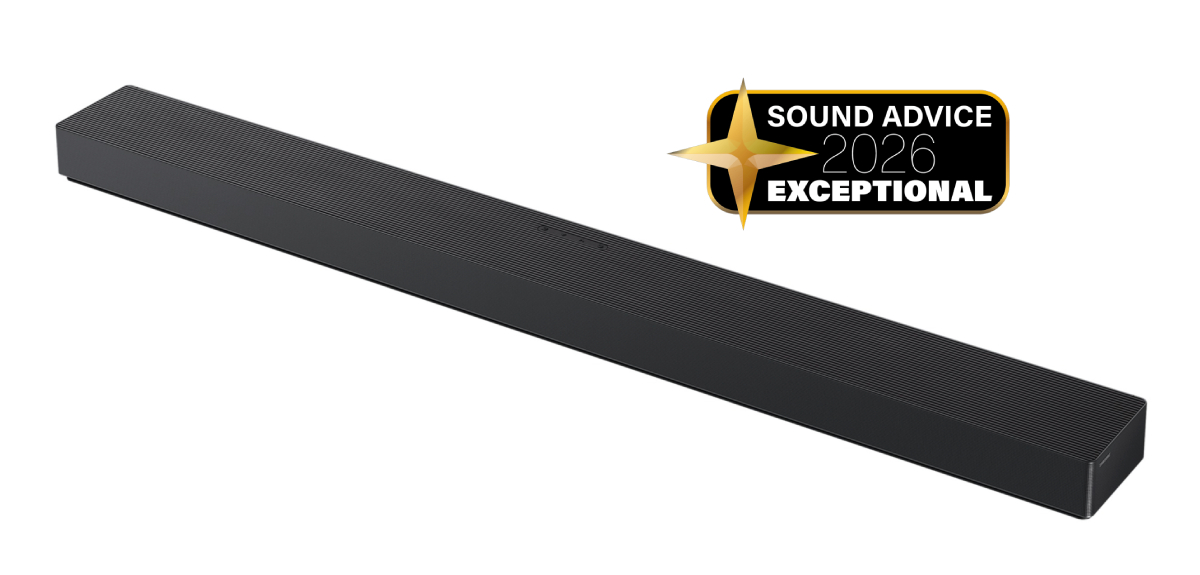
Awesome though Samsung’s flagship HW-Q990H soundbar might be, it’s also… a lot. At £1499 it’s a lot of money, and given its inclusion of two rears and a chunky subwoofer alongside the main soundbar a lot of speakers too. If it all sounds a bit much one way or the other, though, fear not: Samsung also has an ideal alternative for you in the simple shape of the £849 HW-QS90H. It’s a single-component multi-channel soundbar that can be truly (as opposed to half-arsedly) adapted for either wall or desktop placement.
Sound quality
Despite only shipping as a single bar, the HW-QS90H still squeezes in 13 drivers delivering a 7.1.2 channel count. That works out as forward-firing left, right and centre channels, front/side left and front/side right channels, side left and right channels, two up-firing drivers for Dolby Atmos/DTS:X height effects, and an integrated bass system of four dedicated woofers.
While this speaker- and channel-count is impressive in itself for a soundbar which, at 69 x 1245 x 125mm (HxWxD), is only mid-sized by premium soundbar standards, what really makes the QS90H stand out is the way its drivers can alter the channels of sound they output depending on the soundbar’s orientation. For instance, the drivers used as up-firing channels when the QS90H is sitting flat on a desktop are reconfigured to become front-firing when you wall-hang it, enabling it to rest as flat against the wall as it sits flat on a desktop. Similarly, the front-firing speakers in the desktop orientation become up-firing speakers in the wall hanging orientation. There’s even a built-in gyroscope so the soundbar automatically knows which drivers need to be outputting which channels. Most soundbars can be wall-mounted as well as placed flat under your TV, of course. However, wall-mounted soundbars usually have to be hung on the wall in the same stance in which they sit on a desktop, meaning they stick out a long way and produce a sound that typically seems to be coming from too high up to sound right for your seating position.
The QS90H isn’t Samsung’s first ‘convertible fit’ soundbar rodeo. Unlike 2025’s HW-QS700F, though, the QS90H doesn’t ship with an external subwoofer - instead it squeezes those four bass woofers into the main soundbar. While this makes sense from a design perspective, the worry has to be that it will compromise the QS90H’s performance - especially with movie soundtracks.
Happily the QS90H wastes no time in putting such concerns to bed. Pushing it hard with the rumble-tastic Dolby Atmos likes of Blade Runner 2049 and 1917, the amount of low frequency power, resonance and depth the QS90H pumps out is truly outstanding for a single-bar solution.
Extended rumbles always emerge smoothly and cleanly even at extreme volume, while also rolling out with enough force to fill your room and fulfil the non-directionality feature that’s so key to convincing home cinema bass performance.
If you really go looking for it there is a ceiling to the QS90H’s bass performance that isn’t present with the external subwoofer-toting QS700F. The levels of volume and depths of bass frequency required to cause the QS90H’s bass to start sounding a touch coarse, though, will rarely be encountered in a typical home environment - and so they don’t stop the the QS90H’s bass efforts going far beyond the vast majority of premium single-bar soundbar rivals.
Maybe the single best thing about the QS90H’s outstanding bass, though, is the way it doesn’t compromise any other aspect of the soundbar’s performance. The scale, volume and raw power of the soundstage it creates, for instance, is phenomenal for a single-bar soundbar. Regardless of which configuration - flat or wall mounted - you’re using it in.
Detailing with movie soundtracks is impeccable. Location effects are steered to exactly the right places and given exactly the right relative weight, and even high-pitched effects avoid sounding brittle or harsh. Voices, meanwhile, not only appear locked to the mouths of whoever’s speaking, but never sound hummy, muddy or shrill.
Voices always sound like they’re coming from your TV screen, too, rather than appearing stuck in the soundbar below. Samsung even features ‘Sound Elevate’, which lets you vertically ‘lift’ vocals if you have a really huge screen or your soundbar sits unusually low. Vocals sound perfectly contextualised within the overall mix, too - especially if you deploy Samsung’s ‘Space Fit’ system when first setting your QS90H up. ‘Space Fit’ is essentially Samsung’s auto-calibration system, adapting the soundbar’s output to your room set up. Unusually, though, it isn’t a system you run once and that’s it. It constantly monitors the QS90H’s sound for issues - including bass balance - and corrects the sound profile accordingly.
Rather than just creating a flat wall of sound when portraying height and left/right extremes like many soundbars do, the QS90H’s soundstaging has genuine three-dimensionality to it, commandingly filling the area between your seated position and the screen. There’s even a sense of sound coming from the side of your viewing position at times. As there are no rear speakers you don’t get that full hemisphere of sound that Dolby Atmos and DTS:X soundtracks can give you with systems that include them, of course - this is true of pretty much all single-bar solutions, though, and if you want to add rear speakers to the QS90H then you can. Options include the SWA-9500S rear speaker set or the company’s new Music Studio 7 speakers - the latter can also be used as standalone wireless music speakers.
The QS90H has the power and timing to deliver impact sounds with fantastic venom and precision when required, and despite its compact size it also delivers transitions around the soundstage with outstanding precision and believability. Its midrange attaches immaculately to the bass frequencies of the integrated woofers too, as well as being dynamic enough to ebb and flow effortlessly through the peaks and troughs of even the most extreme action- and horror-scene moments.
All of the above strengths are delivered regardless of which placement profile you’re using the QS90H in. There’s no repeat of the slight height-channel ‘funnelling’ effect you get with the QS700F when wall-hanging it, and the way the relatively large, round drivers on the QS90H’s top edge (in desktop mode) become forward-facing drivers (in wall-hanging mode) enables the soundbar to deliver a much wider sound than regular wall-mounted soundbars can.
The QS90H sounds stellar with music, too. Staging with stereo tracks is excellent, delivering strong left/right separation while retaining vocals in a slight elevated spot at the heart of the mix. Instrumental and vocal layers are presented cleanly without becoming forensic or artificial, and there’s a genuinely musical tone on show that’s actually hard to reconcile with the soundbar’s massive movie soundtrack presentation. The QS90H also intelligently reins in its bass a touch for music to ensure it always feels like a balanced contributor rather than becoming a dominant or inconsistent nuisance. The timing and weight of bass contributions to music of all flavours is excellent, too - maybe even slightly better than it was with the QS700F and its external subwoofer.
The QS90H isn’t perfect, of course. Occasionally movie vocals can become a touch clipped and hard-edged under real duress. In wall-mounted mode, the sound doesn’t project forwards quite as forcefully as it does in desktop mode, or sound quite as bass-rich. Arguably this makes the QS90H’s music performance slightly preferable in its balance and tone to the desktop presentation.
Living with the Samsung HW-QS90H
The QS90H is about as easy to live with as a soundbar is ever going to get. After all, precious few other soundbars are truly designed for effective, slimline wall mounting as well as low-profile desktop placement. And even fewer - literally a handful - can adjust their speaker configuration to adapt themselves perfectly to separate desktop and wall-hanging configurations.
You might argue that most people will know if they intend to place a soundbar on a desktop or a wall before buying, and so don’t need a soundbar that can adapt to either placement. But I’d say you never know how your AV set up may change over time - and in any case, the QS90H sounds better whichever way you’re using it than the vast majority of less flexible soundbars. So it’s still a great option even if you don’t anticipate using its convertible fit feature.
Controlling the QS90H is easy, whether you’re using the included, low button-count remote control, or the Samsung Smart Things or Samsung Sound apps. I suggest using the apps because a) the soundbar doesn’t carry an LED display, and b) they provide access to certain features, including the ‘Sound Fit’ calibration system, that aren’t accessible from the remote control.
The QS90H’s connectivity is decent. Particularly welcome is a ‘one in/one out’ HDMI loop-through system capable of delivering gaming-friendly refresh rates of 1440p@120Hz resolution (the QS90H doesn’t support full 4K@120Hz pass-through though). The HDMIs can also pass HDR10, HDR10+, HLG and even Dolby Vision HDR formats.
The QS90H supports music streaming via Apple Airplay, Chromecast, Spotify Connect and TIDAL Connect out of the box, as well as being Roon Ready. Its HDMI output supports eARC functionality too, and will accept lossless Dolby Atmos from eARC-enabled TVs.
The QS90H can also receive Dolby Atmos wirelessly (but not losslessly) from compatible Samsung TVs. It also supports Samsung’s Q Symphony feature, so the soundbar can join forces with the speakers in a Samsung TV rather than simply replacing them.
Conclusion
The HW-QS90H combines highly unusual placement flexibility, compact single-component design and fantastic sound quality to make it one of the most complete and effective ‘pure’ soundbars I’ve ever encountered. The fact it does all the things it does for just £849 makes it something of a bargain, too - even if you don’t anticipate really needing its ‘convertible fit’ capabilities.
Add in a choice of high quality rear channel upgrade paths and, in its own different, cheaper way the QS90H becomes almost as desirable as its flagship Q990H sibling.
Test Samples
Blade Runner 2049 4K Blu-ray
No movie puts sound systems through the wringer harder than Blade Runner 2049, with its brutal combination of soaring synths, huge industrial beats and overwhelming drones, rumbles and bass drops. The QS90H takes almost all of it in its stride, though, with only the film’s most extreme bass drops causing even a hint of coarseness in the otherwise epic and pristine presentation.
The Invisible Man (2020) 4K Blu-ray
When your main antagonist is literally nowhere to be seen, sound design becomes even more important to a film than usual. Happily the QS90H is sensitive enough to pick up and correctly place all of The Invisible Man’s brilliantly designed Dolby Atmos cues, tricks and placement effects, while also delivering its sudden impact sounds and thumping score with all the potency your nerves will be able to handle.
The The Infected
While the QS90H excels with every type of music I try on it, there is something particularly special about the power, scale, detail and purity of its presentation of The The’s classic Infected. This album’s dense-but-clean mix played nicely with the mode on the QS90H that can remix stereo sound to use all of the soundbar’s available channels.
The QS90H combines extremely rare genuine multi-placement support for either wall-hanging or desktop placement, complete with speaker/channel reconfiguration, with outstanding power, clarity and soundstage scale. It sounds great with music as well as movies too, and manages to integrate remarkable amounts of bass into its single-bar form to save you from having to accommodate an external subwoofer.
Samsung’s Q Symphony feature makes Samsung TVs particularly good companions for the QS90H, as you can use the TV’s speakers to expand the centre channel’s scope and clarity. Many Samsung TVs also support wireless Dolby Atmos streaming to the QS90H.
A soundbar like this deserves to be fed best-quality audio sources where possible, so I’d recommend combining it with a 4K Blu-ray player in order to enjoy the lossless, uncompressed versions of Dolby Atmos and DTS:X that you can only get from the latest physical media format. Streamed Dolby Atmos is always compressed.
Finally I would consider at some point adding either Samsung’s SWA-9500S wireless rear speaker options or, if you want more versatile (but also more expensive) add ons, maybe a pair of the company’s new Music Studio 7 speakers.
