Award winner
Find at
For a fair while now, compact disc has widely been regarded as a spent force - a format that, if not actively seen as ‘dead’, is definitely on the glide slope towards the end of its life. The sheer volume of discs in circulation mean it was never going to disappear overnight, but the idea of releasing a brand new, standalone CD player seems to make less and less sense. Throughout 2026, though, CD has been staging a bit of a fightback. A huge amount of dirt-cheap, high-quality media that doesn’t get delisted whenever a streaming service has a snit has seemingly won over a new cohort of fans.
NAD might not seem like the obvious choice of company to be getting on this particular bandwagon as it is incredibly proficient at streaming - but historically the company is very handy at disc spinners too, and the C589 is here to remind us why they are so well-regarded.
As many of the devices NAD intends you should connect a C589 to are capable of streaming, the spec of their CD player is intentionally bare bones. It plays compact discs via a front loading mechanism and outputs that signal via analogue and digital inputs. If you want SACD, digital inputs or streaming, you have come to the wrong place.
NAD has been encouragingly thorough about the hardware the C589 uses, though. Built around a ‘pro level’ ESS DAC, the C589 is a fully balanced design, able to supply both digital and analogue balanced signals as well as single-ended ones. This is relatively unusual at this price and makes the NAD a usefully flexible piece of equipment.
NAD has also taken the opportunity to equip the C589 with some of the bespoke digital hardware I’ve seen on its streamers. The first is ‘Dynamic Digital Headroom’ (DDH) - this is a proprietary audio technology intended to eliminate inter-sample peak clipping (the distortion that happens when music peaks fall between digital samples during digital-to-analogue conversion). This is joined by ‘Qrono D2A’, which is designed to reduce timing errors. Both of these can be switched in or out of the signal path, so you can choose to implement them or not. It’s worth noting that, if this technology is of interest to you, the NAD is the only CD player you can buy that supports them.
Sound Quality
For all the initial listening to the C589, I turn the additional processing off and listen to it as a ‘normal’ unit (insofar as any brand new CD player in 2026 is ‘normal’) - and used this way, the NAD is capable of very impressive results. The single most important element of the C589’s performance is that it is outstandingly natural and free of any sense of the processing power in the decoding. Instead, the NAD does an impressive job of getting out of the way of what is being played, and puts very little of itself into the performance. This is not a ‘fast', ‘smooth’ or ‘detailed’ player so much as a genuinely accurate take on the contents of the disc itself.
This means that with genuinely good CD masters (and your reminder at this point: before the loudness war became A Thing, some were truly amazing), the NAD can have you questioning whether all the effort expended on hi-res has actually been worth it. Voices and instruments are delivered with a tangibility and vibrancy that has you listening through the NAD, rather than to it - which is a quality even some very sophisticated digital sources lack. The bass extension on offer is also extremely good. The low end is never overblown or dominating (unless the recording demands it) but there is excellent definition and control to lower notes that means you appreciate the extra detail that results.
Experiments with the ‘DDH’ and ‘Qrono’ settings produce slightly different results. I’m someone with quite a few CDs from the late nineties and early 2000s, some of which are recorded loud with limited dynamic range, and the ‘DDH’ software is genuinely useful. It manages to put some air and space into these frequently very brittle-sounding discs without the whole effect sounding smoothed off or lacking in energy. ‘Qrono’ is a slightly different affair because I find the effects extremely subtle to the point of being a bit “is this thing on?” for much of the time. With very complex time signatures, I find it can impart a slightly greater sense of order and control but the effect is never night-and-day. It can be easily accessed from the remote to switch in and out, though.
Something that is rather less subjective and more repeatable is that, if you have an amplifier that does its best work via an XLR input, the NAD is a truly exceptional balanced source. The ESS hardware it is built around is naturally balanced, and there is a boost to the soundstage and overall realism of the performance that is genuinely impressive. The focus on the decoding rather than fitting a load of dubiously useful extra functionality pays dividends.
Living with the NAD C589
One of the challenges of building a brand new compact disc player in 2026 is that the number of actual CD mechanisms available isn’t very high. NAD doesn’t supply a great deal of information about where it has sourced the C589’s mech from, but it manages to load discs in good time, rotate them without making much noise, and can play discs that some PC-derived solutions can struggle with (see Listening Notes below). It struggles a little with badly damaged discs - but no more than other players I’ve tried recently.
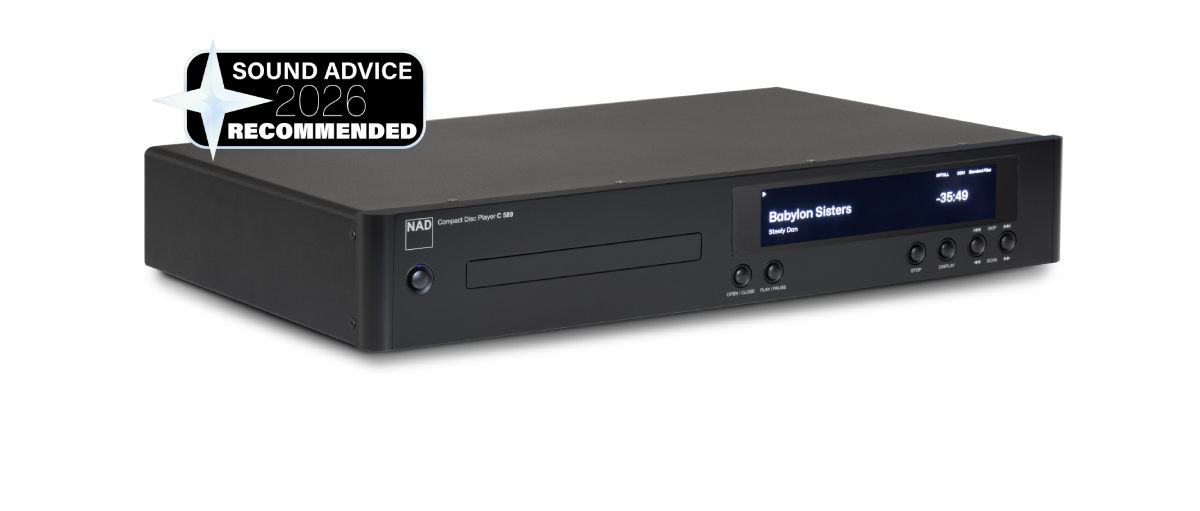
The C589 is part of the core NAD range, which means it comes in the trademark grey finish. This is darker than it once was, which makes partnering it up outside of NAD equipment easier than before - but it’s still not a true black (if that matters). It is well made, and there is a decent selection of physical controls on the front panel which makes using the NAD without a remote pretty simple. The remote itself isn’t terribly beautiful either, but it’s well laid-out and easy to use.
NAD has elected to equip the C589 with a large white-on-black display which can show CD Text - and a very good job of that it does too. Sadly, as CD Text was never a hugely common feature on discs, it means that for a lot of the time, the amount of information actually showing on this large display could easily be handled by something a quarter of the size. Compared to some recent CD player arrivals that can access the outside world and use it to find metadata and album art, the NAD feels a bit more old-school in what it does and how it goes about doing it.
Conclusion
Ultimately, if you judge products by how they sound rather than their bells and whistles (and that’s the ideal, really), the NAD shines out from its sober casework. This is an exceptionally capable digital source that proves there is plenty of life left in the optical disc should you choose to embrace it.
Listening notes
ZZ Top Fandango!
This half-live, half-studio effort lets the NAD show off its ability to handle crude recordings (and the live bit is crude) without destroying them, before revelling in the superb blues rock of the later tracks.
Various Artists WipeOut 2097
Not a normal test disc, this. It is in fact a Playstation game disc with the (superb) electronic soundtrack encoded as tracks after the game files. Many modern CD players can’t read the files but the C589 can.
The Shamen Axis Mutatis
The Shamen’s follow-up to the hit Boss Drum is profoundly weird. The NAD delivers its sumptuous production and cavernous bass to excellent effect, revealing that for all the weird subject matter it’s a good listen.
If you have a healthy CD collection, a balanced amplifier and a desire for some no-nonsense quality to get the best from both, the C589 is very hard to ignore. The NAD does less to give you more.
It won’t be a perfect styling match but the balanced input of the Quad 33/303 is going to be a perfect partner for the NAD and the result is likely to be sonically excellent.