Award winner
Find at

.webp)
Linn, of course, has more previous than most audio companies when it comes to digital audio in general and network streaming in particular. Its Majik DS-I launched in 2009, back when the overwhelming majority of its nominal rivals were still fretting about whether or not to build a docking station for the latest iPod. The first Majik DSM followed three years later - and now here’s the fifth generation of a product type that is becoming ubiquitous thanks in no small part to Linn itself.
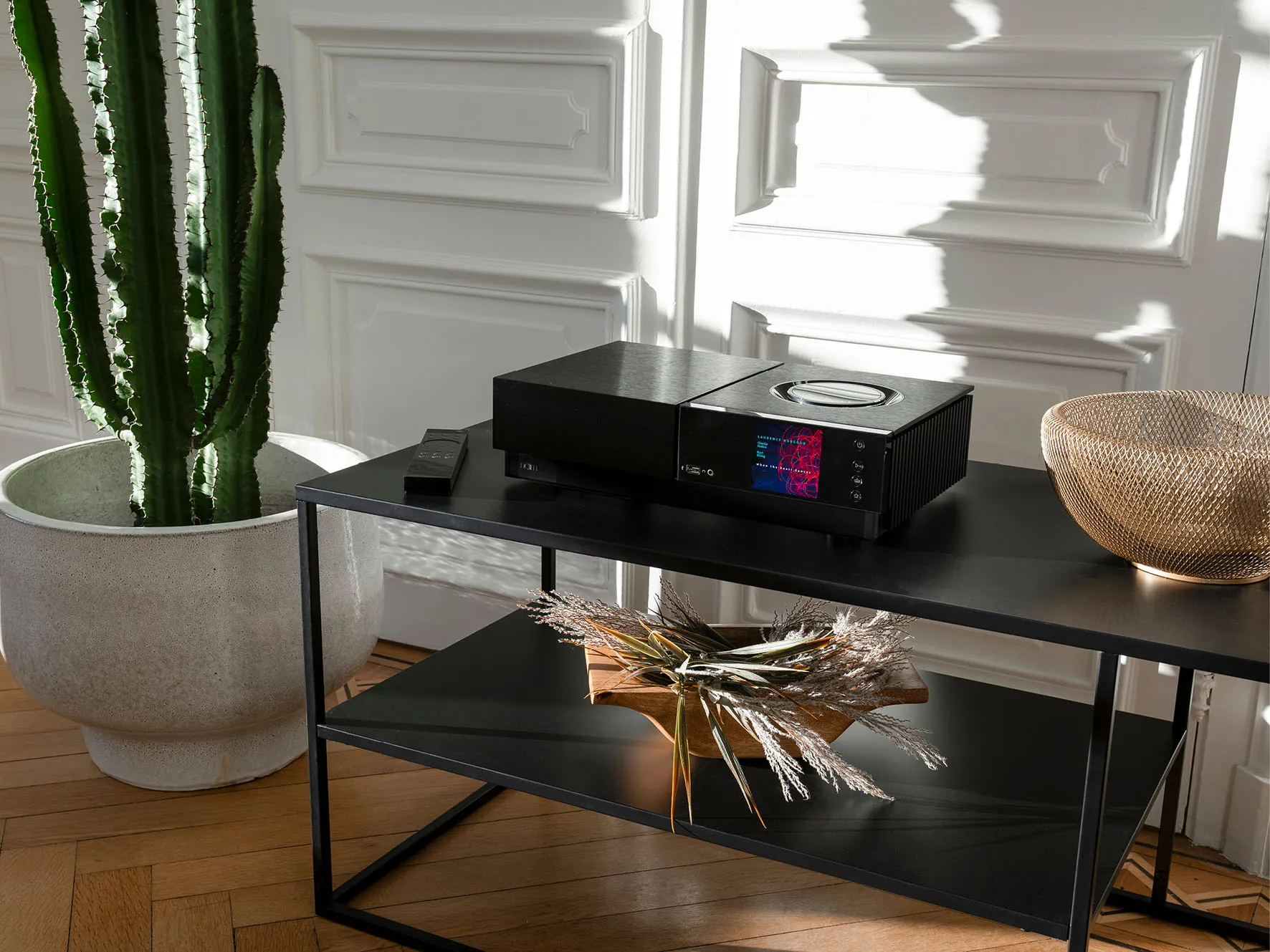
The Majik DSM (5th Gen) is not, in visual terms, all that distinct from previous Majik DSM models. Not that this is automatically a bad thing, you understand - a product built in Glasgow, mostly from a single 2mm sheet of punched, cut and folded aluminium that’s been powder-blasted to a satin-like finish, is always going to create a strong visual impression. The welcome appearance of Linn’s signature cut-glass control dial (which sits on the top of the box, where it mirrors the central foot on which the Majik DSM stands), which features 100 gently glowing LEDs that indicate the level of volume dialled in, only adds to the impression of expensive good taste.
Things are no less agreeable on the inside. Class D amplification, built around Texas Instruments amplifier modules and based closely on the power amp cartridges found in Linn’s pricier Selekt DSM modular streamer, is good for 50 watts per channel into an eight-ohm load - and that figure doubles as impedance halves. Digital-to-analogue conversion uses AKM converter chips with in-house clocking and upsampling circuitry - it’s derived from the high-end Katalyst DAC that debuted in the even-more-expensive Klimax DSM. Scrimping, it seems safe to say, has not occurred.
Naturally enough, the Majik DSM (5th Gen) has a generous selection of wireless and physical inputs. The wireless stuff is covered by Bluetooth 4.2 (a courtesy, really, and hardly at the standard of every other one of the Linn’s inputs) and dual-band wi-fi - this allows the machine to be Roon Ready, to access internet radio, and to handle the ‘Connect’ version of Spotify as well as Apple AirPlay 2.
Physical connectivity runs to an Ethernet socket (of course), a USB-C slot, an optical Toslink input, an S/PDIF coaxial that can function either as an input or an output, and an HDMI eARC to round out the digital stuff. Analogue inputs consist of a couple of line-level inputs on stereo RCA connections, a moving magnet phono input and a moving coil alternative. There’s a single line-level output, two pre-outs for use with subwoofers, a pair of loudspeaker binding posts and, on the fascia, a 6.3mm headphone socket.
sound quality
With one minor caveat, there’s nothing to dislike about the way the Linn Majik DSM (5th Gen) goes about making music. Quite the opposite, in fact - it’s easy to admire and periodically worthy of being loved.
So yes, ‘minor caveat’ - I may as well get it out of the way right now. At the top of the frequency range, the Linn is absolutely as confident and positive as it dares to be. There’s nothing splashy or edgy about the way it describes treble sounds, you understand - but this top-end assertiveness could conceivably be exacerbated by source equipment or, especially, loudspeakers that are similarly forthright where the highest frequencies are concerned. In a system matched even remotely sympathetically, though, this won’t be an issue - you’ll simply be served treble sounds with all their bite and shine fully intact.
And in every other meaningful respect, the Majik DSM (5th Gen) displays plenty of expertise and no little élan. Its tonal balance (presuming a sympathetic system) is even and neutral - for all of its abilities where detail retrieval, dynamic and harmonic variation, rhythmic expression and so on are concerned, the Linn doesn’t seem all that inclined to assert itself where tonality is concerned. Whatever the flavour of your recording, that’s how this machine serves it up.
Low-frequency control is such that the Majik DSM might, on first acquaintance, sound a little tentative where bass is concerned - but listen just a little longer and the real story becomes apparent. This device punches hard and digs respectably deep - but it allows absolutely no overhang where the lowest frequencies are concerned, and this alacrity means a) rhythms are described with complete confidence, and b) the uncommon speed and momentum of its low-end reproduction makes this much more of a welterweight than a heavyweight. It’ll still punch your lights out, mind you.
The soundstage the Linn creates is expansive, rigorously controlled and entirely plausible. Even when a large ensemble is occupying the space, the relative position of individual performers is apparent, and the space between them is more than enough to allow everyone a bit of breathing space. And the distance it is able to put between the quietest sections of a recording and the crescendo is difficult to quantify - but be assured, it’s a lot.
But most impressive of all is the tangible unity and togetherness of the way the Majik DSM (5th Gen) presents music. Linn has always maintained that time alignment - the discipline of ensuring that every scrap of frequency information reaches the listener’s ears at precisely the same time - is key to creating a fully convincing sensation of musicality and performance. And the Majik DSM is most assuredly musical and most certainly creates an impression of singularity in the music it delivers - so it may be that the company is really on to something…
living with
At 114 x 350 x 372mm (HxWxD) the Majik DSM (5th Gen) is neatly proportioned somewhere between a full-size hi-fi component and the shoe-box dimensions of something by the likes of Cyrus. The standard of construction, fit and finish are all beyond reproach - this looks and feels like a premium product, which is just as well in the context of the asking price.
Controlling the Linn can be done in a couple of different ways. The company supplies a remote control handset that covers the fundamentals, and also features half-a-dozen user-assignable ‘shortcut’ buttons. There’s also a control app for iOS and Android which is more extensive in its functionality - as well as duplicating the functions of the remote control, it can integrate some of the more popular music streaming services. It’s a clean, quite good-looking user interface - and while it might not be the most responsive app you ever used, it will get you where you want to go if you just exhibit a little patience.
The front fascia, once the machine has woken from standby, is featureless beyond the headphone socket - unless you deploy the app or the remote control. Then it wakes up to reveal a crisp, bright, high-contrast display that shows a welter of relevant information and allows you to navigate some very straightforward set-up menus. Unlike the majority of streaming amplifiers that have, to a lesser or greater extent, taken inspiration from Linn’s efforts in this field, though, there’s no album artwork or any other niceties. ‘Text’ is what you get, and plenty of it - so if you hanker after a virtual VU meter or what-have-you, you’ll need to look elsewhere.
What no other alternative offers, though, is anything even remotely like Linn’s ‘Space Optimisation’ software. Tell the Majik DSM (5th Gen) all about your listening space, from the speakers you’re using to the material that the floor is made out of (and plenty more besides) and it will set itself up to best suit your specific environment. If it’s a straight choice between this kind of attention to detail where performance is concerned or a display with a spectrum analyser, I know which I’ll choose.
conclusion
I’m aware that it’s only ‘affordable’ by the standards of everything else in the company’s product line-up - but when you consider it in terms of flexibility, of pride of ownership, and most importantly of all in terms of sonic prowess, the Linn Majik DSM (5th Gen) might conceivably constitute a bargain. Just take a moment or two when choosing the speakers that it will be driving…
listening notes
Laars None
There’s no greater test of rhythmic positivity than a 122bpm dancefloor head-nodder - and when given this particularly insistent groove to deal with, the Linn aims straight for the hips and hits the jackpot
The Smiths Shoplifters of the World Unite
The Majik DSM’s ability to unify a recording into a tangible whole is amply demonstrated here - and its unerring ability to describe the tonality of a voice or an instrument without any colouration gets a worthwhile look-in too
Malcolm Strachan Soul Trip
The razor-sharp attention the Linn pays to the attack and, even more importantly, the decay of low-frequency information allows the engine of this recording plenty of momentum. It’s the foundation on which the tune just builds
You buy a Linn Majik DSM (5th Gen) because you understand and admire the company’s principles where sound reproduction is concerned. You buy it because you have a fairly sizable (and high-performance) system you need amplified, because you’re into high-quality network streaming, and because you have (or will have) the loudspeakers to do some justice to these electronics. And because you know there’s really no more cost-effective way to get into ownership of audio equipment from a brand that’s among the most auspicious and credible around.
Linn will suggest a pair of its new 119 standmounters, or 150 floorstanders (which we tested as part of a brand-centric system here) but they’re by no means your only option. It’s certainly worth investigating the Bowers & Wilkins 705 S3 Signature (which I used for the majority of my testing), and don’t overlook the PMC prophecy5 either.