
Don’t go thinking this is ‘just’ a soundbar. Not only is the new Bose Lifestyle Ultra Soundbar a premium Dolby Atmos soundbar the likes of which any number of deeply credible manufacturers are busily throwing into the market, it’s also part of the Lifestyle Ultra ‘Collection’. Admittedly this collection so far consists of the soundbar, a wireless speaker and a wireless subwoofer (called, you’ll be less-than staggered to learn, ‘Lifestyle Ultra Speaker’ and ‘Lifestyle Ultra Subwoofer’), but other products are likely to follow. A smaller soundbar, for starters, is fairly strongly hinted at.
That doesn’t mean the Lifestyle Ultra Soundbar can’t operate in isolation, mind you. Bose suggests this product will let you enjoy the sonic height and width that’s the whole point of a Dolby Atmos soundtrack, as well as crystal-clear dialogue and a fair amount of low-frequency oomph, even before you consider the idea of some rear speakers or a dedicated subwoofer.
To get the job done it’s kitted the Lifestyle Ultra Soundbar with nine drivers. Bose being Bose, of course, details of specification are in vanishingly short supply - if you want to know about the size, or composition, or frequency response of these drivers, you’re out of luck. And the same applies should you want to establish how much amplification is on board in order to power them.
What I DO know is that there are four ‘racetrack’ full range drivers across the front of the soundbar, with a tweeter in the middle dealing specifically with centre-channel information. There’s a driver at each end, of Bose’s proprietary ‘PhaseGuide’ design that intends to spread sound horizontally to give the impression of drivers where there are none. And then there are two full-range drivers angled up at 90 degrees on the top surface of the soundbar, where they are designed to generate that all-important height. This array is bolstered by two ‘QuietPort’ bass reflex ports at the rear of the soundbar - there’s one either side of the cutaway in which the physical connectivity is stashed.
Bose has brought plenty of processing power to bear in an effort to make the Lifestyle Ultra Soundbar the default choice for those with a grand to drop on an all-in-one spatial audio system. For instance there’s the AI-driven ‘Speech Clarity’ feature, designed to make dialogue easier to discern without just turning the whole soundtrack up. ‘TrueSpatial’ wants to make non-spatial audio content sound as immersive as possible, and it’s going to try its hardest whether you want it to or not. Then there’s ‘CleanBass’, operating in conjunction both with the ‘QuietPort’ openings and with DSP to ensure low frequencies are as free from distortion as possible. ‘CustomTune’ works with the mic in an iOS or Android device to help the soundbar optimise its output to suit both your room and your favourite seating positions. It’s quick, thorough and pretty accurate, and it makes the Lifestyle Ultra Soundbar a little more adaptable than it otherwise would be.
sound quality
Connected to a decent OLED TV via HDMI, and with sources including several streaming services, a 4K UHD Blu-ray player and a games console as well as terrestrial TV broadcasts, the Bose Lifestyle Ultra Soundbar doesn’t take long to establish its credentials. In every single sonic respect, it wipes the floor with the unassisted sound of the television (and the same goes for your TV too, unless you spent a great deal of money on the most successful of those Philips/Bowers & Wilkins collaborations from the fairly recent past). In fact, it’s so accomplished and so straightforwardly enjoyable to listen to that it’s ready to give the very best of its price-comparable rivals a run for their money.
I have to start somewhere, though, so I may as well start with frequency response. The Bose digs very deep at the bass end, and hits with a very agreeable combination of solid power and quite carefully described texture and detail. It can do ‘thump’ with the best of them, but it’s emphatically not a blunt instrument - there’s light and shade to the low-end presence here, as well as the sort of martial control of attack and decay that allows any music playing to have its rhythm expressed with real positivity.
The midrange projects well - it’s forward and distinct even when the rest of the soundtrack is in uproar, and as a consequence dialogue is always explicit. It doesn’t sound remote from the rest of the frequency range, though - instead it’s an integral part of an overall whole, but is always capable of maintaining its presence even in the least promising of circumstances. And the top of the frequency range is bright and reasonably substantial, despite the fact the speaker’s lone tweeter is badly outnumbered by drivers covering the rest of the frequency range too. Treble sounds have bite and shine, and carry just as much detail (both broad and fine) as the rest of the frequency.
The frequency response is reasonably smooth and consistent - there’s perhaps a suggestion of the lowest frequencies being pushed slightly forwards, but that’s a) kind-of understandable in the context of the product type, and b) easily remedied in the control app. Tonality, too, is just a smidgen on the warm side of neutral - but it’s a trait rather than a shortcoming, and isn’t entirely inappropriate when it comes to handling a state-of-the-art Hollywood blockbuster spatial audio soundtrack.
Oh yes, spatial audio. The combination of physical drivers at helpful angles and some undoubtedly fiendishly complicated DSP means the Lifestyle Ultra Soundbar sounds bigger than its physical dimensions in every direction and almost comically so when it comes to height. Given a decent Dolby Atmos soundtrack to deal with, there’s appreciable width and depth to the soundstage the Bose presents, as well as more than little hint of the sonic height which is the whole point of the format. There’s great unity to the sound to go along with the scale, too - some spatial audio soundbars can sound a little vague, or struggle to create a sense of singularity to the huge numbers of discrete elements they’re asked to deal with, but that’s not the case here. There’s a togetherness about the way the Bose presents a soundtrack, as well as a real sense of positivity - it’s a direct and communicative listen. It’s dynamic too, able to put considerable distance between that moment when our hero hisses the plan at their accomplice and the almighty explosion that immediately follows.
The Lifestyle Ultra Soundbar is an only slightly more qualified success when it comes to music. The fact the ‘TrueSpatial’ feature can’t be defeated is occasionally problematic - not every recording suits being delivered by nine drivers when it was designed to be delivered by two, and some of the positivity the Bose exhibits with soundtracks can sometimes go astray as a result. And compatibility with TIDAL Connect can’t come soon enough - this streaming service is one of the major platforms for Dolby Atmos music, and the equivalent streamed via Bluetooth really isn’t a convincing alternative. Otherwise, though, the Bose remains as deftly punchy and informative with music as it is with movies.
living with the bose lifestyle ultra soundbar
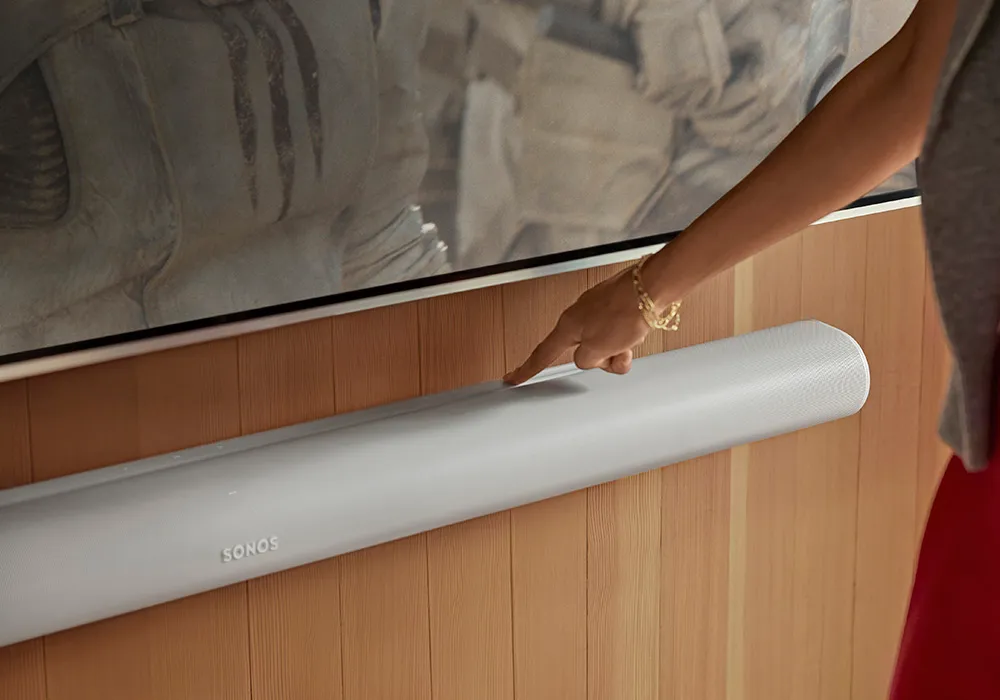
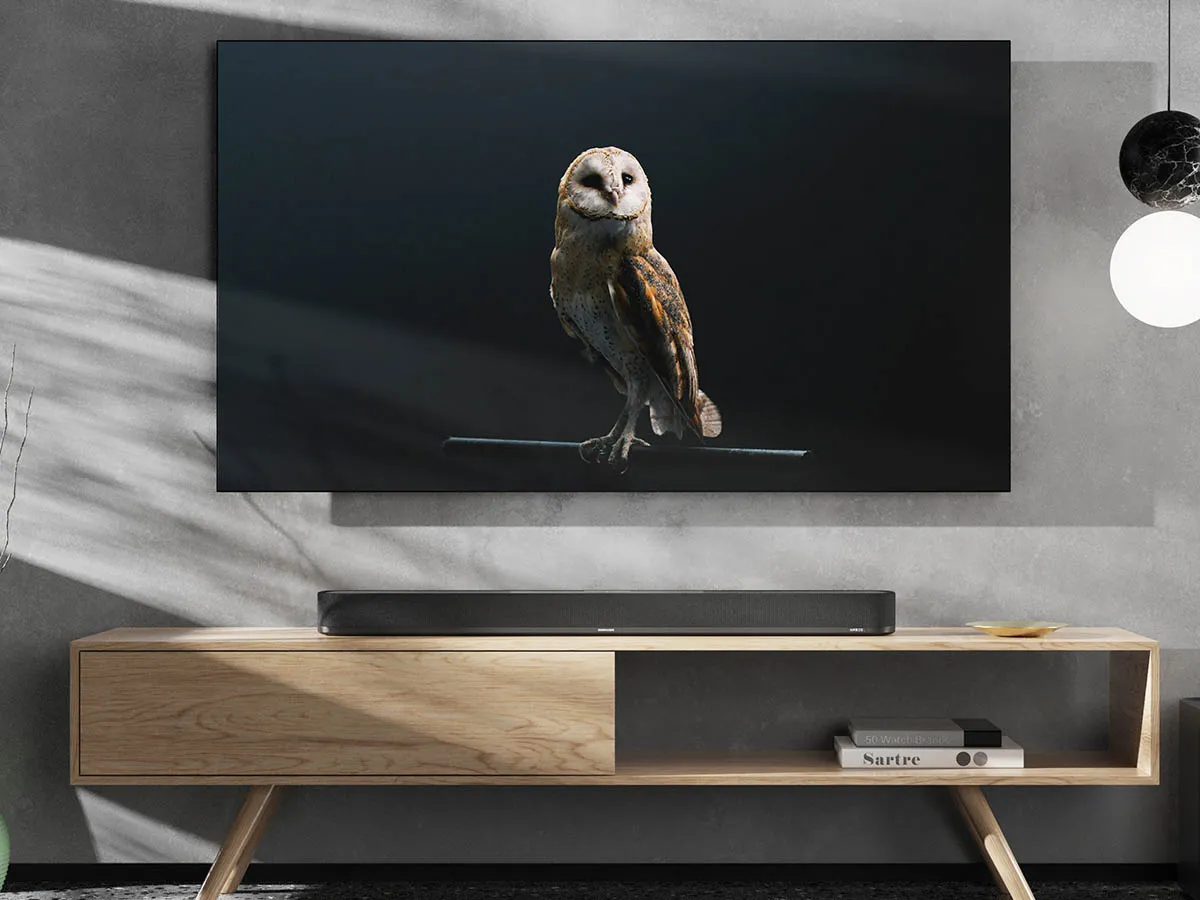
At 67 x 1110 x 125mm (HxWxD), the Bose Lifestyle Ultra Soundbar is no shrinking violet, and is quite obviously designed to accompany TVs of no less than 55in or so. Happily, its relative bulk is mitigated somewhat by the elegantly curved shape of its cabinet and the absolutely impeccable standard of build and finish that it exhibits. No matter if you choose the black finish or the ‘white smoke’ alternative, you’ll be in possession of a product that looks and feels the money’s-worth.
There’s a quite obvious misstep where design is concerned, though. I’m sure the idea of a quantity of glass to cover most of the top of the soundbar seemed a capital idea during product planning meetings, and there’s no denying it makes the Bose look as expensive as it is. But if it’s anywhere near the bottom of a TV - which, let’s face it, is hardly beyond the realms of possibility - it readily reflects the light and the colours that are on the screen. Admittedly this is much less of an issue when watching 21:9 content with black bars top and bottom that it is when watching content that occupies the entire screen, but it’s a strange decision nevertheless.It was a weird design flourish when the likes of Sony were doing it a few years back, and it’s kind-of remarkable that Bose has decided to ignore the pelters the likes of Sony were on the receiving end of at the time.
Wireless connectivity is covered by Bluetooth 5.3 and dual-band wi-fi. The latter brings AirPlay and Google Cast into play, as well as allowing the soundbar to be compatible with Spotify Connect - TIDAL Connect will apparently be along any moment now, which is just as well for those of us with an interest in Dolby Atmos music. The former allows swift connectivity for music - but in established Bose fashion, there’s no mention of the specifics where codec compatibility is concerned.
The physical stuff consists only of an Ethernet socket and an HDMI eARC socket. Bose isn’t the first company to ignore the option of an HDMI passthrough when specifying its premium soundbar, which means it isn’t the first company that I will criticise for having done so. And it’s worth noting at this point that the Bose can deal with Dolby Atmos spatial audio but not the DTS:X equivalent - this is another thing Bose is not the first company to have decided on.
Controlling the Lifestyle Ultra Soundbar can be done in a number of different ways. There’s a circular control dial on the top of the chassis - it’s embedded into that troublesome glass panel and it covers play/pause, skip forwards/backwards and controls volume in the manner of an old-school iPod, needing a circular finger-swipe. Next to it there’s a trio of touch-sensitive controls that run to Bluetooth pairing, mute mics (the Bose has Alexa voice control built in) and a shortcut button, the use of which is defined in the Bose app.
The app is, in true Bose fashion, visually uninspiring but very useful and thorough indeed. Everything from the room-correction routines and input selection to EQ adjustment (for ‘centre’, ‘height’ and ‘surround’ as well as ‘treble’, ‘bass’ and ‘mids’) is available here, in stable and logical fashion.
What you don’t get, though, unless you’re prepared to spend a little more money, is a remote control handset. I’m tempted to suggest that between physical, app and voice control, as well as the ability to use an appropriate TV’s remote control when the television is connected via HDMI, this is a sensible move by Bose. I don’t doubt that some users will see this omission as symptomatic of a wider and more general malaise, though.
conclusion
The positives outweigh the negatives here to a significant degree. Really, all you’ll have to do to talk yourself into ownership of the Bose Lifestyle Ultra Soundbar is accept that odd glass top-plate for the wanton design flourish it, ignore the lack of HDMI passthrough and be much more interested in spatial audio for movies than you are for music. Reach these accommodations and you’ll be in possession of one the most capable soundbars this sort of money can buy.
listening notes
Bumblebee Dolby Atmos Netflix
When it all kicks off - and it’s generally all kicking off in this movie - the Bose is able to give proper weight and welly to the low-frequency activity while remaining clean and controlled at the same time. Any old soundbar can rumble, but it takes an accomplished device to bring some light and shade to the bottom end.
Cyberpunk 2077 Dolby Atmos Playstation 5
Let’s see… detail retrieval, low-frequency impact, midrange projection, dynamic variation? Here’s a game that carefully examines all of these aspects, as well as offering the opportunity to indulge in some stunt spatial audio work too. It’s a challenge the Lifestyle Ultra Soundbar rises to with something that sounds very much like relish.
Dune Dolby Atmos 4K Blu-ray
Dolby Atmos soundtracks just don’t come any more spacious or any more punchy than this - and there aren’t that many that bury their dialogue quite so deep either. The Bose does tremendous work in making the spaces large and dark, hitting with real conviction, and bringing positivity and clarity to dialogue in the midrange.
You buy a Bose Lifestyle Ultra Soundbar because you want to put a huge spatial audio-style rocket up your TV’s sound, because you fancy the idea of a subwoofer and rear speakers at some point perhaps, because you know an elegant piece of industrial design when you see one, and because you won’t be positioning it so close to the bottom of your television that its glass top will reflect light too readily.
A big television with great picture quality and underwhelming sound would seem the best bet - and there’s quite a few to choose from. The LG G6 is a great example of a stunning-looking, mediocre-sounding TV that could be transformed into the heart of a very gratifying home cinema surround-sound system by the Lifestyle Ultra Soundbar.