
Award winner
Find at
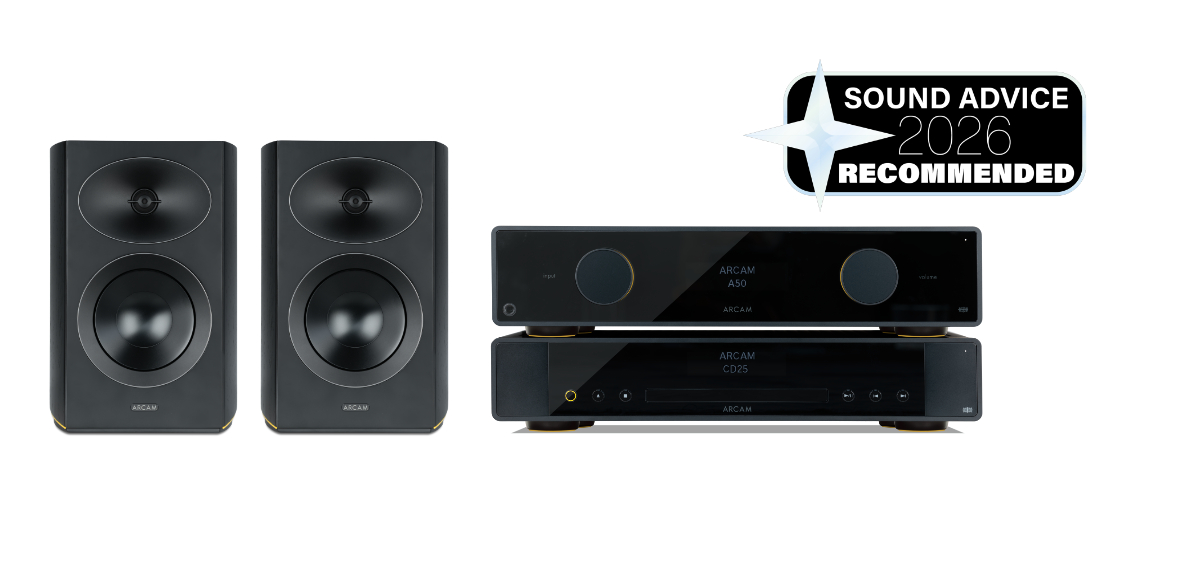
It’s been a busy time at Arcam lately. An expanding range of electronics, a new loudspeaker series for the first time in actual decades… and the small matter of a 50th birthday to be celebrated. I’m sure a glass or two has been raised on Arcam premises, but naturally the company has also chosen to mark its half-century in the way it knows best - with a couple of new products.
The A50 Signature integrated amplifier has been developed, in large part, by John Dawson. John co-founded A & R Cambridge back in 1976, ‘A & R’ standing for ‘amplification and recording’, and the company’s first product was the legendary A60 integrated amplifier. So what other sort of product would be appropriate to get the treatment in 2026?
The A50 Signature is no throwback or tribute act, though - it’s entirely fit for 21st century purpose. It features Arcam’s Class G amplification in a dual-mono arrangement, with each channel built as an entirely discreet amplifier section. It’s good to the tune of 150 watts per channel into an eight-ohm load, and features the digital smarts alongside the analogue stuff that today’s user requires.
Three unbalanced line-level analogue inputs on RCAs are joined by a balanced equivalent on XLRs, and there are inputs for both moving magnet and moving coil-equipped turntables. Digital stuff is covered by an HDMI eARC socket, a USB-C slot, a couple of coaxial inputs and an optical alternative. The A50 Signature is a Bluetooth transmitter and receiver, and features Auracast along with codec compatibility all the way to aptX Lossless. Physical outputs consist of line-level pre-outs and binding posts for a single pair of speakers, and there’s a 6.3mm headphone socket on the fascia.
The digital stuff is dealt with by a none-more-fashionable ESS Sabre ES9039Q2M DAC chipset. It can handle resolutions of up to 32bit/384kHz if the content arrives via USB-C, while it tops out at 24bit/192kHz from any of the other digital inputs.
The CD25 doesn’t carry John Dawson’s signature, but it nevertheless is also designed to celebrate Arcam’s birthday - and to constitute the company’s flagship compact disc player. It’s the first Arcam design in a very long time to adopt dual-mono DAC architecture, using two of those ESS Sabre ES9039Q2M, and the very first to implement that company’s ‘Hyperstream 4 DAC’ technology. Each DAC processes one channel in balanced mode in an effort to keep noise to an absolute minimum - and naturally Arcam has gone to significant lengths beyond this. A linear toroidal transformer means clean power, and internal vibration damping should ensure flawless disc-reading and low-noise operation. Outputs include balanced XLR alongside unbalanced RCA - so the CD25 can make a balanced analogue connection to the A50 Signature. In the (admittedly unlikely) event your system features more accomplished digital-to-analogue conversion than is fitted to the CD25, there are coaxial and optical digital outputs too.
At the front end of this system is a pair of R25 standmount loudspeakers. No one is pretending the company’s first new range of loudspeakers in donkey’s years, of which the R25 are the larger of two standmounting models, has anything to do with the 50th anniversary - but it doesn’t do any harm to be able to offer a complete end-to-end solution.
The R25 is a two-way design bolstered by a rear-venting bass reflex port, and features a 25mm ‘deep ceramic composite’ dome tweeter inside a waveguide and an acoustic lens designed for wide dispersion of high-frequency sound. It sits above a 165mm ‘micro ceramic composite’ mid/bass driver in a proprietary frame that’s designed to combine low weight with maximum rigidity and cooling. An inverted surround is intended to maximise cabinet diffraction while concealing the mounting system at the same time. Frequency response is a claimed 43Hz - 40kHz, and there are bi-wire speaker cable terminals at the rear of each R25 cabinet which the A50 Signature cannot fully exploit. Mind you, the ostensibly tricky figures of 85.5dB @ 1m 2.83V sensitivity and six ohms nominal impedance are absolutely no issue to the amplifier.
sound quality
Obviously each part of a three-element system is contributing to the overall sound - but what’s striking about this A50 Signature / CD25 / R25 set-up is just how nicely balanced and musical its presentation is. ‘Musical’ may seem like a redundant description, but I’ve heard enough audio equipment that isn’t especially musical to know what I’m getting at.
There’s a degree of warmth to the tonality here, but nothing fatal - the suggestion of heat does nothing to damage the impression of balance and clarity. At the bottom of the frequency range the Arcam set-up hits with determination and discipline, controlling the attack and decay of bass sounds carefully and expressing rhythms confidently as a result. There’s transparency at the bottom end as well as solidity, and the amount of detail (both broad and fine) the system identifies and reveals means there’s light and shade to go along with the muscle.
The top of the frequency range summons a polite level of attack and, again, there’s remarkable clarity and openness to the way it’s presented. There’s proper body to treble sounds, which serves to balance the level of bite and brilliance the Arcam can muster - and detail levels are every bit as high here as elsewhere in the frequency range, so there’s plenty of variation to the top-end information that’s made available. In between, the midrange communicates like nobody’s business - there’s a positivity and an articulacy to the way this system describes voices that means you’re never in any doubt as to the intent or character of a voice.
The entire frequency range hangs together well - the Arcam tilts the overall response towards the lower frequencies, no doubt about it, but transitions from bottom to top are smooth and convincing. The fact that the set-up creates a wide, well-defined soundstage doesn’t do any harm, either - the layout is explicit, the spaces between elements are confidently described, and the whole presentation is unified and offered as a singular whole. There’s a sense of togetherness and of performance to the Arcam system’s sound that is very easy indeed to get used to.
Dynamic headroom is considerable, and both the amplifier and the speakers seem able to track huge up- or downshifts in intensity or attack or straightforward volume without sounding in any way stressed. There’s absolutely no shift in attitude at big volumes, either - the system simply gets louder (much louder if needs be) without altering the fundamentals of its character in the slightest. The lower-level dynamics of harmonic variation aren’t overlooked either, and the system’s overall policy of revealing absolutely as much detail as possible means the feeling of being in receipt of a complete picture is always strong.
living with the Arcam A50 Signature / CD25 / R25
Any colour you like, as long as it’s black (with yellow accents). Arcam has stuck to its design guns for these three products - the electronics are in black metal chassis with glass front panels, OLED displays and a very occasional splash of yellow to offer a bit of relief. The speakers, meanwhile, are in a black ash veneer everywhere except the front baffle and the slightly smaller integrated plinth on which the main body of the cabinet rests. Seen from above the speaker cabinets are a quite pronounced teardrop shape, and this curviness is echoed in the profile where the cabinet meets the plinth - it’s a line that is accentuated by featuring, of course, a yellow line. The speakers are also supplied with magnetically attached grilles.
Both boxes of electronics feature fascia controls and each is supplied with a little remote control handset that’s mostly black but features a little dash of - well, take a wild guess. Both the fascia controls and the remote handsets are quite positive in their action, and reliable in operation - and the display on each fascia is bright, crisp and of a size that’s legible across even quite a large room.
Set-up is absolutely no kind of hardship. As well as featuring a socket for mains power, both the amplifier and the CD player have a power on/off switch at the rear - so once connected to the mains, but before switching the power on, the CD player can be connected to the amp using any of the four output options - I find balanced XLR most effective. The amp is then connected to the speakers - the speakers enjoy a little toe-in towards your listening position, but not as much as some alternative designs. Power up the electronics, slip a CD into the smooth-sliding and silent tray, select the relevant input and appropriate volume level on the amp, and you’re good to go. Be aware, though, that while the gap between pressing ‘stop’ and ‘eject’ and actually having your compact disc returned to you isn’t interminable, it will soon begin to feel like it.
Like all worthwhile audio equipment, the Arcam system gives its best when offered decent support and isolation. Thanks to its Class G technology the amplifier doesn’t get especially warm, but nevertheless it’s best to ensure there’s a decent little gap between its top surface and any shelf that might be above it.
conclusion
Not being the best player in a brilliant team doesn’t mean you’re not a great player - so just because the R25 loudspeakers can’t quite hit the remarkable heights their partnering electronics can achieve doesn’t mean they’re bad speakers. And they’re more than revealing enough to allow the excellence of their partners shine through, which means that when taken as a trio this system has an awful lot to recommend it. If you’re prepared to accept the notion that the speakers can be improved upon without spending any more money, though, there’s a chance you may be able to exploit the brilliant electronics here even more fully…
listening notes
Alicia Keys If I Ain’t Got You
The remarkable powers of midrange resolution the Arcam system offers are given every chance to shine here - Keys offers a combination of technique and emotional directness that is made absolutely obvious. There’s just no ambiguity to the way this set-up delivers her voice, and consequently a level of intimacy and insight that’s by no means a given no matter how much money you’re spending.
Dave Pike Set Mathar
If it’s tonal neutrality you’re after, a proper taste of the intensely savoury flavours of a recording like this one, the Arcam trio will do an admirable job for you. The contrast between sharp, straight-edged sitar and brushed, rolling percussion is strong - but the system still describes the recording as a singular and coherent whole.
Simple Minds Theme for Great Cities
Before they fantasised about being U2, Simple Minds fantasised about being a powerhouse of kosmische musik - and it was the more successful (as well as more noble) ambition. This instrumental is a tremendous opportunity for the Arcam trio to showcase its ability with rhythmic expression and authority - heard this way it rolls along in the most unforced and naturalistic manner imaginable.
You buy an entire three-piece Arcam system because you’re a stickler for visual and aesthetic harmony - but more importantly you buy it because it’s about as well-rounded and sympathetic a CD-based set-up as this sort of money can buy. The disc player is among the very best around at the money, and the amplifier can form the high-performing heart of a very expansive system if you so desire - and it carries some historical resonance without being any kind of pastiche.
