Award winner
Find at
If we were to create an ‘unsung heroes of vinyl’ award (to be clear, we’re not - but work with me on this), Audio Technica would be in the running for top spot. Throughout the years when vinyl was officially ‘dead’ it diligently kept churning out high-quality phono cartridges that meant people who kept the faith had the means to keep playing records through those dark times. In more recent years, these cartridges have been updated - and very good they are too.
Audio Technica also makes a range of turntables that come supplied with some of this extensive range of cartridges. In recent years, the company has been expanding its turntable operation and moving into higher price points, both increasing the number of markets it competes in and broadening the places it can put its cartridges. The AT-LPA2 is the latest arrival, and pushes the company into an all-new price point.
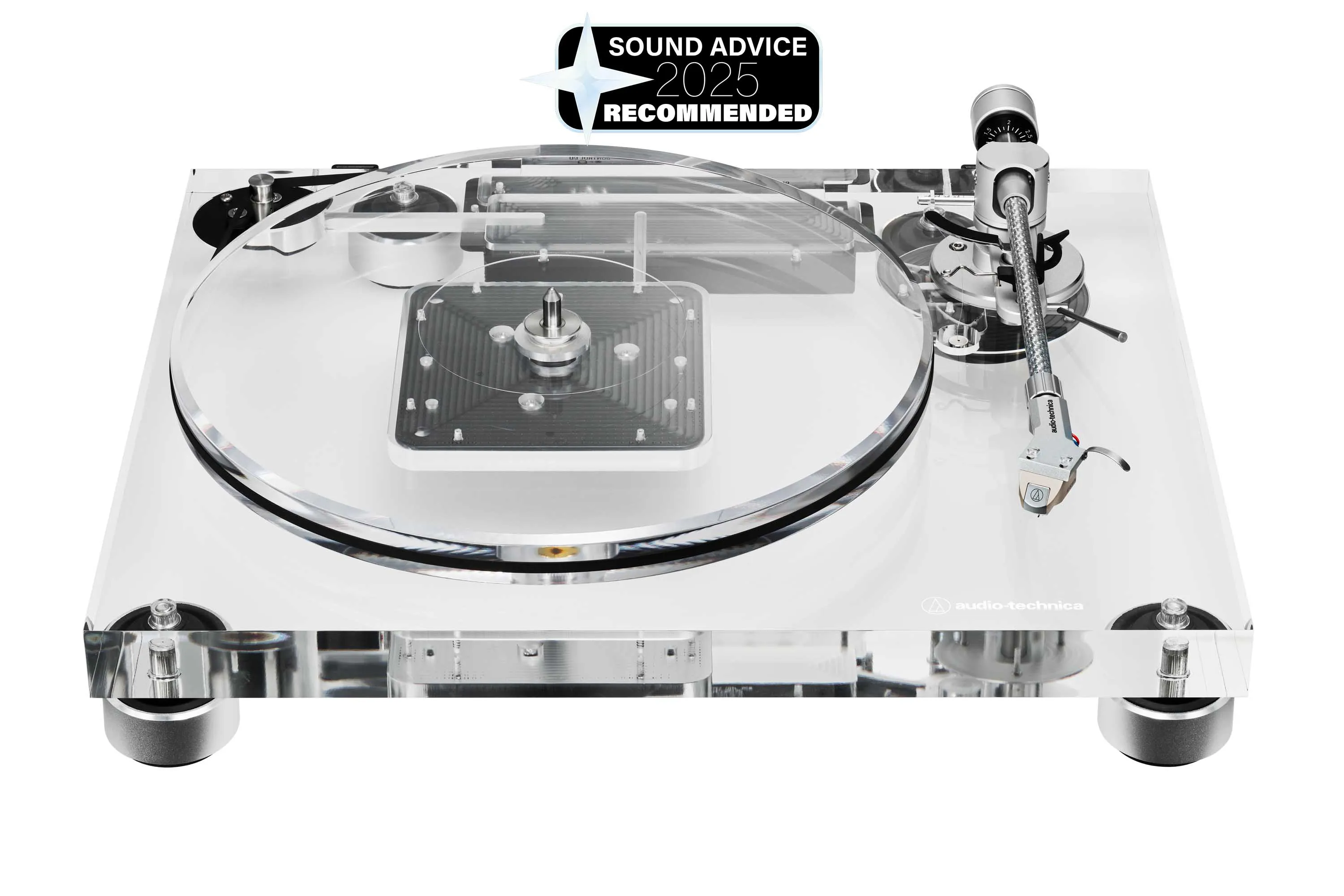
The good news is that the Audio Technica doesn’t arrive looking or feeling out of place. The choice of acrylic for the plinth and platter isn’t one made for looks alone (although we’ll come to that), but because it’s a material that offers similar resonance properties to that of a record. Which means when a record is on the platter they effectively become one and the same thing.
The tonearm is not made of acrylic (which is a good thing) and has been developed specifically for the LPA2. It takes the form of a straight armtube that is made from carbon fibre. It uses fixed bearings for both the horizontal and vertical axes, and it feels solid and well engineered.
There are some oddities though. The antiskate system uses the line-and-weight principle, and this works very well - but the line is sufficiently long that the weight needs to be recessed into a hole in the chassis, which is a little odd. It also uses a detachable headshell to mount the cartridge. This is far from unusual… except it’s a different type to almost all the headshells that Audio Technica sells individually.
The fact that there’s an AT-OC9XEN moving coil cartridge parked in that headshell is very good news, though. It’s a member of the highly regarded OC9 family, and it is one of the very best cartridges available at under £500 - and having one included in the price of the LPA2 is a significant boost to the Audio Technica’s shelf appeal. You will need a moving coil phono stage for this to work, but it promises excellent performance if you do.
Something else the LPA2 has which is a departure for Audio Technica is an external power supply and speed control. This allows you to select between 33.3 and 45rpm without having to go near the belt - and Audio Technica says it isolates the sensitive audio components from power supply noise, resulting in a cleaner, more accurate sound. Some brief strobe checks here suggest the speed accuracy is very good indeed.
Sound Quality
Brains are funny old things. Look at the LPA2 glinting in the light and you subconsciously begin thinking that it’s going to deliver a bright sound. If you let your ears rather than your eyes do the listening, the Audio Technica turns out, in fact, to be an exceptionally refined bit of kit. Quite a bit of this can be laid at the door of that OC9XEN cartridge. There once was a time when Audio Technica moving coil cartridges could be a little on the forward side, but this latest generation has impressive levels of refinement.
What’s clever about this is the Audio Technica is still perfectly capable of sounding fast and exciting when you need it too. One of the elements in turntable design you’ll notice as you throw more money at the ‘problem’ is how the better-engineered decks can keep making sense of dense and congested passages of music when lesser models start to lose the feeling of three dimensionality and control. The LPA2 keeps things together impressively well, even when judged at the newly elevated price. It is both ordered and impressively articulate.
Some of this feeling of articulation stems from the fact that, if you are being hypercritical of the Audio Technica, it doesn’t have quite the same bass impact as some other designs at similar money. The bass you do get is detailed, though, and able to start and stop with the sort of enthusiasm that means even very high tempo material feels punchy and engaging. It might not punch as hard as some turntables, but the LPA2 lands those punches very well.
The true forte of the Audio Technica is the tonal realism and engagement it offers. As long as the rest of the signal path is up to the job, this is a turntable that will do justice to voices and instruments in a way that not much else at under £2000 can keep up with. The combination of that capable cartridge and vinyl-friendly construction materials results in a turntable that genuinely warrants the term ‘hi-fi’ rather than any form of nostalgic fondness. It generates a level of engagement that compels you to keep listening to it. ‘Just one more record’ is going to be a line you hear yourself thinking pretty often if you own one of these.
Living with the Audio Technica AT-LPA2
I am not and have never been, a style icon. My thoughts on design and aesthetics should be given no greater credence than those of any other soul on the planet. Even so, I feel confident in saying that very few people will look at the LPA2 and say ‘that’s a bit ugly.’
This isn’t a cheap record player but, compared to quite how pricey record players can be, there is very little anywhere near the price that looks and feels as special as this one does. The use of acrylic gives the Audio Technica an almost ephemeral quality crossed with a sense of an engineering cutaway - because all the parts that make the Audio Technica actually work can be seen.
The good news is that there is no suffering for your art here. This is not a hard turntable to set up and use, and it comes with everything you need to get up and running. Aside from threading the antiskate weight being a mite fiddly, nothing else should prove a challenge for anyone willing to read a manual and not rush. I also feel that the inclusion of a lid is something that Audio Technica should be congratulated on; the LPA2 is cat- and small child-proof in a way that quite a few designs doing the rounds at this price are not.
Some aspects of the design do need to be taken into account, though. Moving the power supply to a separate chassis helps the performance but does mean that you need a bit more room for the Audio Technica. The use of a moving coil cartridge (with no option to order it without) means you need a moving coil-capable phono stage - and these are far rarer to encounter as built-in devices in integrated amps, so you’ll be needing more room to put a suitable phono stage on the rack too.
One final aspect of the Audio Technica’s design warrants mention. Like most semi-sanely priced turntables, it has no suspension and uses four hefty feet to isolate the playing surface. These feet are effective up to a point - tap the plinth when the deck is playing and you’ll hear it but tap the surface the deck is on and you largely won’t. ‘Largely’ is the key word here. If you want the very best performance the LPA2 can offer, I would suggest a wall shelf or isolation platform.
Conclusion
The AT-LPA2 is far more than a pretty face. It’s a cleverly designed and executed piece of analogue engineering that sounds as good as it looks. Audio Technica’s move upmarket has been achieved to a very high standard, and it’s likely to win many people over.
Listening notes
East India Youth Culture of Volume
An album that combines superb vocals combined with huge crunching slabs of electronica gives the Audio Technica a chance to show off its impressive dexterity and superb tonal realism.
Fink Distance and Time
One of the more gorgeous and intimate albums from Finn Greenall, this is a chance to revel in the Audio Technica’s refinement, airiness and outstandingly convincing presentation.
Little Barrie and Malcolm Catto Electric War
Recorded on all analogue, retro studio gear and given a great pressing, this is a chance for the LPA2 to show just how capable it is at keeping everything sounding cohesive and convincing.
If you can accommodate its moving coil output and give it the space it needs, very little else at the price is going to sound better than the LPA2 while looking smarter. This is statement design that delivers on the sound too.
For absolute aesthetic and sonic joy, the Quad 33/303 pre-amp and power amp combo would be a stylish, sonically capable and moving coil phono stage-equipped partner that would make for a pretty beautiful system. Round things off with Neat’s supremely talented Petite Classic and you’ll have as much fun as you can have with your clothes on.